Short answer
A counterbalance forklift almost always weighs more than the load it is rated to lift — typically 1.4 to 1.9 times its rated capacity. Across the machines in our database the median published service weight is 4,210 kg (9,281 lb), and they run from 545 kg (1,202 lb) for a pedestrian pallet truck to 7,811 kg (17,220 lb) for a large diesel truck. If you only know the capacity, multiply it by about 1.6 and you will usually be inside 15%.
Most pages that answer this question give you an average and stop. An average is not much use when you are working out whether a trailer is rated for the machine, or whether a mezzanine will take it. What you actually need is either the figure for your truck, or a way to estimate it from something you do know.
This page gives you both: the published service weights of 59 real machines, and the relationship between weight and capacity that lets you estimate the rest.
The rule that gets you close: weight follows capacity
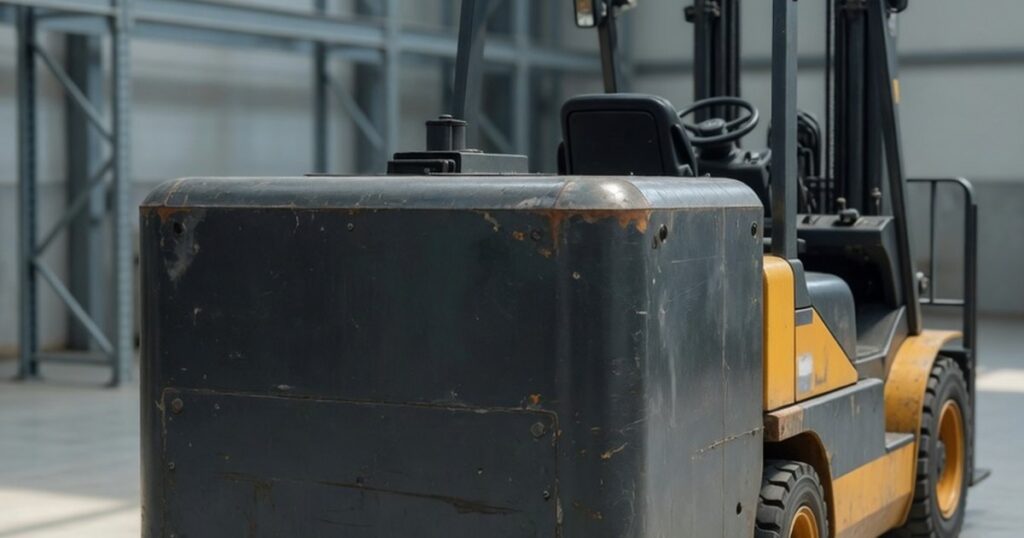
A counterbalance forklift is a lever. The load hangs in front of the front axle, and the truck balances it with mass behind the axle. Lift more, and you need more mass. That is why weight tracks capacity so closely, and why the ratio is stable enough to be useful.
Measured across the counterbalance trucks in our database, service weight comes out at about 1.6× the rated capacity for a diesel truck and 1.8× for an electric one. Electric trucks sit higher because the battery is doing double duty: it powers the truck and it is a large part of the counterweight.
| Machine type | Service weight vs rated capacity | Why |
|---|---|---|
| Diesel counterbalance | about 1.4–1.8× | Cast counterweight plus engine, transmission and fuel. |
| LPG counterbalance | about 1.4–1.9× | Same layout, lighter fuel system, similar counterweight. |
| Electric counterbalance | about 1.4–2.4× | The battery is the counterweight, so the spread is wide: two trucks of the same capacity differ by the pack fitted. |
| Reach truck | about 1.7–2.6× | Rated at a load centre it reaches out to, so it carries proportionally more mass for the capacity. |
| Pallet truck | about 0.3× | No counterweight at all. The load sits over the wheels, so a truck that lifts two tonnes can weigh under 600 kg. |
Ranges measured across the machines listed below. They are a sanity check, not a substitute for the figure on the truck.
Published service weights, by machine type
Every row below is a real model, and every figure is the one its manufacturer publishes. The source column links to the document.
Diesel and LPG counterbalance forklifts
| Model | Type | Operating Weight | Rated Lift Capacity | Maximum Lift Height | Source |
|---|---|---|---|---|---|
| Hyster H5.5FT | Diesel Forklifts | 7,811 kg (17,220 lb) | 5,500 kg (12,125 lb) | 2,740 mm (9.0 ft) | Hyster H4.0-5.5FT Series Technical Guide, Rev 03-01/19 |
| Hyster H5.0FT | Diesel Forklifts | 7,520 kg (16,579 lb) | 5,000 kg (11,023 lb) | 2,740 mm (9.0 ft) | Hyster H4.0-5.5FT Series Technical Guide, Rev 03-01/19 |
| Hyster H4.5FT6 | Diesel Forklifts | 7,027 kg (15,492 lb) | 4,500 kg (9,921 lb) | 2,740 mm (9.0 ft) | Hyster H4.0-5.5FT Series Technical Guide, Rev 03-01/19 |
| Hyster H4.5FTS5 | Diesel Forklifts | 6,826 kg (15,049 lb) | 4,500 kg (9,921 lb) | 2,740 mm (9.0 ft) | Hyster H4.0-5.5FT Series Technical Guide, Rev 03-01/19 |
| Hyster H4.0FT6 | Diesel Forklifts | 6,470 kg (14,264 lb) | 4,000 kg (8,818 lb) | 3,000 mm (9.8 ft) | Hyster H4.0-5.5FT Series Technical Guide, Rev 03-01/19 |
| Hyster H4.0FT5 | Diesel Forklifts | 6,264 kg (13,810 lb) | 4,000 kg (8,818 lb) | 3,000 mm (9.8 ft) | Hyster H4.0-5.5FT Series Technical Guide, Rev 03-01/19 |
| Hyster H3.5A | Diesel Forklifts | 4,910 kg (10,825 lb) | 3,500 kg (7,716 lb) | 3,880 mm (12.7 ft) | Hyster H2.0-3.5A Product Technical Guide, part 3991741 Rev 02-04/22 |
| Hyster H3.5FT | Diesel Forklifts | 4,799 kg (10,580 lb) | 3,500 kg (7,716 lb) | 3,055 mm (10.0 ft) | Hyster H2.0-3.5FT Series Technical Guide, part 3990285 Rev 01-10/18 |
| Hyster H3.0A | Diesel Forklifts | 4,642 kg (10,234 lb) | 3,000 kg (6,614 lb) | 3,880 mm (12.7 ft) | Hyster H2.0-3.5A Product Technical Guide, part 3991741 Rev 02-04/22 |
| Hyster H3.0FT | Diesel Forklifts | 4,612 kg (10,168 lb) | 3,000 kg (6,614 lb) | 3,055 mm (10.0 ft) | Hyster H2.0-3.5FT Series Technical Guide, part 3990285 Rev 01-10/18 |
| Hyster H2.5A6 | Diesel Forklifts | 4,292 kg (9,462 lb) | 2,500 kg (5,512 lb) | 3,900 mm (12.8 ft) | Hyster H2.0-3.5A Product Technical Guide, part 3991741 Rev 02-04/22 |
| Hyster H2.5A | Diesel Forklifts | 3,990 kg (8,796 lb) | 2,500 kg (5,512 lb) | 3,900 mm (12.8 ft) | Hyster H2.0-3.5A Product Technical Guide, part 3991741 Rev 02-04/22 |
| Hyster H2.5FT | Diesel Forklifts | 3,902 kg (8,602 lb) | 2,500 kg (5,512 lb) | 3,250 mm (10.7 ft) | Hyster H2.0-3.5FT Series Technical Guide, part 3990285 Rev 01-10/18 |
| Hyster H2.0A | Diesel Forklifts | 3,613 kg (7,965 lb) | 2,000 kg (4,409 lb) | 3,900 mm (12.8 ft) | Hyster H2.0-3.5A Product Technical Guide, part 3991741 Rev 02-04/22 |
| Hyster H2.0FT | Diesel Forklifts | 3,563 kg (7,855 lb) | 2,000 kg (4,409 lb) | 3,250 mm (10.7 ft) | Hyster H2.0-3.5FT Series Technical Guide, part 3990285 Rev 01-10/18 |
| Model | Type | Operating Weight | Rated Lift Capacity | Maximum Lift Height | Source |
|---|---|---|---|---|---|
| Hyster H3.5A LPG | LPG Forklifts | 4,910 kg (10,825 lb) | 3,500 kg (7,716 lb) | 3,880 mm (12.7 ft) | Hyster H2.0-3.5A Product Technical Guide, part 3991741 Rev 02-04/22 |
| Yale GLP35VX | LPG Forklifts | 4,799 kg (10,580 lb) | 3,500 kg (7,716 lb) | 3,055 mm (10.0 ft) | Yale VX Series LPG Specification Sheet, part 220990296 Rev 02 (2019) |
| Hyster H3.0A LPG | LPG Forklifts | 4,642 kg (10,234 lb) | 3,000 kg (6,614 lb) | 3,880 mm (12.7 ft) | Hyster H2.0-3.5A Product Technical Guide, part 3991741 Rev 02-04/22 |
| Yale GLP30VX | LPG Forklifts | 4,612 kg (10,168 lb) | 3,000 kg (6,614 lb) | 3,055 mm (10.0 ft) | Yale VX Series LPG Specification Sheet, part 220990296 Rev 02 (2019) |
| Toyota 40-8FGU32 | LPG Forklifts | 4,390 kg (9,678 lb) | 3,000 kg (6,614 lb) | 3,345 mm (11.0 ft) | Toyota Core IC Pneumatic Spec Sheet, 2023 |
| Toyota 50-8FGU32 | LPG Forklifts | 4,320 kg (9,524 lb) | 3,000 kg (6,614 lb) | 3,345 mm (11.0 ft) | Toyota Core IC Pneumatic Spec Sheet, 2023 |
| Toyota 40-8FGU30 | LPG Forklifts | 4,280 kg (9,436 lb) | 2,700 kg (5,952 lb) | 3,345 mm (11.0 ft) | Toyota Core IC Pneumatic Spec Sheet, 2023 |
| Toyota 50-8FGU30 | LPG Forklifts | 4,210 kg (9,281 lb) | 2,700 kg (5,952 lb) | 3,345 mm (11.0 ft) | Toyota Core IC Pneumatic Spec Sheet, 2023 |
| Hyster H2.5A LPG | LPG Forklifts | 3,990 kg (8,796 lb) | 2,500 kg (5,512 lb) | 3,900 mm (12.8 ft) | Hyster H2.0-3.5A Product Technical Guide, part 3991741 Rev 02-04/22 |
| Yale GLP25VX | LPG Forklifts | 3,902 kg (8,602 lb) | 2,500 kg (5,512 lb) | 3,250 mm (10.7 ft) | Yale VX Series LPG Specification Sheet, part 220990296 Rev 02 (2019) |
| Toyota 40-8FGU25 | LPG Forklifts | 3,640 kg (8,025 lb) | 2,250 kg (4,960 lb) | 3,340 mm (11.0 ft) | Toyota Core IC Pneumatic Spec Sheet, 2023 |
| Hyster H2.0A LPG | LPG Forklifts | 3,613 kg (7,965 lb) | 2,000 kg (4,409 lb) | 3,900 mm (12.8 ft) | Hyster H2.0-3.5A Product Technical Guide, part 3991741 Rev 02-04/22 |
| Yale GLP20VX | LPG Forklifts | 3,563 kg (7,855 lb) | 2,000 kg (4,409 lb) | 3,250 mm (10.7 ft) | Yale VX Series LPG Specification Sheet, part 220990296 Rev 02 (2019) |
| Toyota 50-8FGU25 | LPG Forklifts | 3,560 kg (7,848 lb) | 2,250 kg (4,960 lb) | 3,340 mm (11.0 ft) | Toyota Core IC Pneumatic Spec Sheet, 2023 |
| Toyota 40-8FGU20 | LPG Forklifts | 3,280 kg (7,231 lb) | 1,800 kg (3,968 lb) | 3,340 mm (11.0 ft) | Toyota Core IC Pneumatic Spec Sheet, 2023 |
Electric counterbalance forklifts
| Model | Type | Operating Weight | Rated Lift Capacity | Minimum Battery Weight | Source |
|---|---|---|---|---|---|
| Hyster J3.5A | Electric Forklifts | 5,746 kg (12,668 lb) | 3,500 kg (7,716 lb) | 1,770 kg (3,902 lb) | Hyster J2.2-3.5A Product Technical Guide, part 3997373 Rev 00-07/25 |
| Linde X35 | Electric Forklifts | 5,536 kg (12,205 lb) | 3,500 kg (7,716 lb) | Not specified | Linde X20-X35 Series 1252 Technical Data (KION North America, 2021 spec sheet) |
| Hyster J3.0A | Electric Forklifts | 5,509 kg (12,145 lb) | 3,000 kg (6,614 lb) | 1,770 kg (3,902 lb) | Hyster J2.2-3.5A Product Technical Guide, part 3997373 Rev 00-07/25 |
| Linde X30 | Electric Forklifts | 5,121 kg (11,290 lb) | 3,000 kg (6,614 lb) | Not specified | Linde X20-X35 Series 1252 Technical Data (KION North America, 2021 spec sheet) |
| Linde X25 | Electric Forklifts | 4,837 kg (10,664 lb) | 2,500 kg (5,512 lb) | Not specified | Linde X20-X35 Series 1252 Technical Data (KION North America, 2021 spec sheet) |
| Linde X20/600 | Electric Forklifts | 4,837 kg (10,664 lb) | 2,000 kg (4,409 lb) | Not specified | Linde X20-X35 Series 1252 Technical Data (KION North America, 2021 spec sheet) |
| Hyster J2.5A | Electric Forklifts | 4,642 kg (10,234 lb) | 2,500 kg (5,512 lb) | 1,480 kg (3,263 lb) | Hyster J2.2-3.5A Product Technical Guide, part 3997373 Rev 00-07/25 |
| Hyster J2.2A | Electric Forklifts | 4,531 kg (9,989 lb) | 2,000 kg (4,409 lb) | 1,480 kg (3,263 lb) | Hyster J2.2-3.5A Product Technical Guide, part 3997373 Rev 00-07/25 |
| Toyota 8FBC18U | Electric Forklifts | 2,365 kg (5,214 lb) | 1,750 kg (3,858 lb) | Not specified | Toyota Core Electric Spec Sheet, 2024 |
| Toyota 8FBC15U | Electric Forklifts | 2,240 kg (4,938 lb) | 1,500 kg (3,307 lb) | Not specified | Toyota Core Electric Spec Sheet, 2024 |
The minimum battery weight column is the one that catches people out. On an electric counterbalance truck the manufacturer specifies a minimum pack weight, because fitting a lighter battery removes counterweight and takes capacity with it. It is a stability figure disguised as an energy figure.
Warehouse trucks
| Model | Type | Operating Weight | Rated Lift Capacity | Maximum Lift Height | Source |
|---|---|---|---|---|---|
| Hyster R2.0HD | Reach Trucks | 4,617 kg (10,179 lb) | 2,000 kg (4,409 lb) | 7,750 mm (25.4 ft) | Hyster R1.4-R2.5 Series Technical Guide, part D435 Rev 00-04/21 |
| Hyster R2.5 | Reach Trucks | 4,230 kg (9,326 lb) | 2,500 kg (5,512 lb) | 4,650 mm (15.3 ft) | Hyster R1.4-R2.5 Series Technical Guide, part D435 Rev 00-04/21 |
| Hyster R1.6HD | Reach Trucks | 4,224 kg (9,312 lb) | 1,600 kg (3,527 lb) | 7,900 mm (25.9 ft) | Hyster R1.4-R2.5 Series Technical Guide, part D435 Rev 00-04/21 |
| Hyster R2.0 | Reach Trucks | 3,801 kg (8,380 lb) | 2,000 kg (4,409 lb) | 4,650 mm (15.3 ft) | Hyster R1.4-R2.5 Series Technical Guide, part D435 Rev 00-04/21 |
| Hyster R1.6 | Reach Trucks | 3,546 kg (7,818 lb) | 1,600 kg (3,527 lb) | 5,000 mm (16.4 ft) | Hyster R1.4-R2.5 Series Technical Guide, part D435 Rev 00-04/21 |
| Hyster R1.6N | Reach Trucks | 3,498 kg (7,712 lb) | 1,600 kg (3,527 lb) | 5,000 mm (16.4 ft) | Hyster R1.4-R2.5 Series Technical Guide, part D435 Rev 00-04/21 |
| Hyster R1.4 | Reach Trucks | 3,495 kg (7,705 lb) | 1,400 kg (3,086 lb) | 5,000 mm (16.4 ft) | Hyster R1.4-R2.5 Series Technical Guide, part D435 Rev 00-04/21 |
| Model | Type | Operating Weight | Rated Lift Capacity | Source |
|---|---|---|---|---|
| Hyster P2.2 | Pallet Trucks | 632 kg (1,393 lb) | 2,200 kg (4,850 lb) | Hyster P1.6-2.2 Series Technical Guide, part A418 Rev 03-09/19 |
| Hyster P2.0 | Pallet Trucks | 632 kg (1,393 lb) | 2,000 kg (4,409 lb) | Hyster P1.6-2.2 Series Technical Guide, part A418 Rev 03-09/19 |
| Hyster P1.8 | Pallet Trucks | 545 kg (1,202 lb) | 1,800 kg (3,968 lb) | Hyster P1.6-2.2 Series Technical Guide, part A418 Rev 03-09/19 |
| Hyster P1.6 | Pallet Trucks | 545 kg (1,202 lb) | 1,600 kg (3,527 lb) | Hyster P1.6-2.2 Series Technical Guide, part A418 Rev 03-09/19 |
What “service weight” on a spec sheet actually means
European spec sheets follow VDI 2198, which numbers every line so that two manufacturers’ sheets can be read side by side. Service weight is line 2.1, and it means the truck ready to work and empty: no load on the forks, no operator in the seat, but with the battery fitted on an electric truck and the fuel or gas system in place on an engine truck.
Two consequences follow, and both matter more than the headline number:
- The truck gets heavier when it picks something up. Service weight plus load weight is what the floor sees. That total is split across the axles, and the split is not even — which is the next point.
- Axle loads, not total weight, are what a floor or a ramp cares about. A laden counterbalance truck puts most of its weight through the front axle, concentrated into two contact patches. Lines 2.2 and 2.3 of the spec sheet give the laden front and rear axle loads, and that is the pair of numbers a structural engineer will ask for.
You can check the arithmetic yourself on any spec sheet: the unladen front and rear axle loads should add up to the service weight, and the laden pair should add up to service weight plus rated capacity. If they do not, something has been transcribed wrong. We run that check on every model we publish.
Where the weight actually matters
Floors, mezzanines and basements
Slab and deck ratings are given per square metre or per square foot; a forklift delivers its weight through a handful of small contact patches instead. The figure to take to the structural drawings is the laden front axle load, not the service weight. Mezzanine decks and suspended slabs over basements are where this goes wrong.
Trailers and transport
Moving a forklift is a trailer-rating problem: the machine’s service weight plus any attachment, against the trailer’s rated payload and the tow vehicle’s capability. The gap between “5,000 pound forklift” meaning capacity and meaning weight is the single most expensive misunderstanding on this page — a 5,000 lb capacity truck is likely to weigh 8,000 lb or more.
Lifts, docks and dock plates
Goods lifts and dock leveller plates carry a rated load that has to cover the truck, the load and the operator together. Again: service weight is the floor of that calculation, not the whole of it.
Four mistakes to avoid
- Reading capacity as weight. “A 2.5 tonne forklift” describes what it lifts. It weighs closer to four.
- Using one figure for a whole model range. Mast height, tyres, cab, battery and attachments all move the number. Two trucks with the same model name can differ by hundreds of kilograms.
- Forgetting the attachment. A clamp or rotator adds its own weight to the truck and takes capacity away at the same time.
- Adding counterweight to fix a capacity problem. This is explicitly prohibited: OSHA 1910.178(q)(6) states that additional counterweighting of fork trucks shall not be done unless approved by the truck manufacturer.
Work it out for your own truck
If what you are really trying to answer is “can this truck lift my load”, weight is only half of it — the load centre matters just as much. Our load capacity and load centre calculator takes the rated capacity from your data plate and shows what is left once the load sits further out or an attachment is fitted.
To look up a specific machine, browse the model database or put two trucks side by side in the comparison tool. Every specification page shows the document each figure came from.
Frequently asked questions
How much does a standard 5,000 lb forklift weigh?
A 5,000 lb (roughly 2,250 kg) capacity counterbalance truck typically weighs between about 7,000 and 9,000 lb, because service weight runs at roughly 1.4 to 1.9 times rated capacity on the machines in our database. The exact figure is printed on the truck and published in its spec sheet.
Why does a forklift weigh more than the load it lifts?
Because the load hangs in front of the front axle. The truck balances that overhang with mass behind the axle — a cast counterweight on an engine truck, and the battery pack plus counterweight on an electric one. Without it the rear wheels would lift.
How much does a forklift battery weigh?
Traction batteries for counterbalance trucks are heavy enough to be structural: the spec sheets in our electric forklift table publish a minimum battery weight precisely because fitting a lighter pack reduces the truck’s stability. Look up the minimum battery weight line for the model you are interested in rather than using a generic figure.
Is service weight the same as operating weight?
They are used interchangeably on most spec sheets, and both mean the truck ready to work with no load on the forks. Where a manufacturer distinguishes them, check whether the operator is included; VDI 2198 line 2.1 does not include one.
Do electric forklifts weigh more than diesel ones?
For the same capacity, usually yes — the battery has to provide counterweight as well as energy, and lead-acid packs are dense. The tables above let you compare like for like: match on rated capacity, then read across.
Sources
- Manufacturer technical guides and spec sheets for every model listed, linked from the source column of each table and from each model page.
- OSHA 29 CFR 1910.178, Powered industrial trucks — paragraph (q)(6) on counterweighting, paragraph (a)(6) on nameplates and markings.
- VDI 2198 — the typesheet standard that numbers the lines on a European forklift spec sheet.