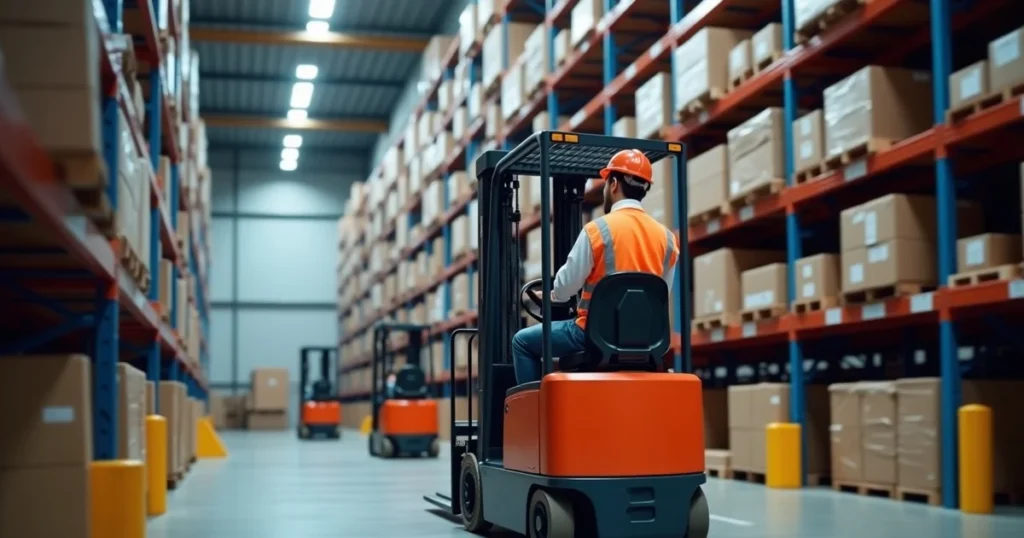
Short answer: Plot the forklift’s centre of gravity (COG) by multiplying the load weight by its vertical height and horizontal offset, then divide by total weight to get the load centre in metres. The stability triangle is the polygon defined by the wheel contact points; the COG must lie inside this triangle. If the COG’s horizontal coordinates exceed the triangle’s bounds, the forklift will tip.
Key takeaways
- The load centre is calculated as (weight × height) ÷ (weight + forklift mass).
- Stability triangles are defined by the wheel contact points; the forklift is safe only if the COG lies inside.
- Derated load capacity must be applied when the load centre is higher than the rated height.
- OSHA 1910.178(q)(7) requires the load centre to be within the stability triangle.
- Use the forklift‑load‑capacity calculator to verify safe load centres for each model.
Last updated: 14 October 2026. Every figure on this page is dated and linked to its source.
What is the stability triangle and why does it matter?
The stability triangle is the polygon formed by the four wheel contact points on the ground. OSHA 1910.178(q)(7) requires the centre of gravity of the forklift and load to lie within this triangle. If it falls outside, the forklift will tip. The triangle’s size varies with wheelbase, track width and load distribution.
How do I calculate the forklift’s centre of gravity for a given load?
COG = (weight × vertical height) ÷ (weight + forklift mass). The result is in metres from the forklift’s centre of gravity reference point. Use the forklift’s mass from the spec sheet and the load height from the load centre diagram.
What is the difference between rated capacity and derated capacity?
Rated capacity is the maximum load the forklift can lift at a specified height, usually 1.5 m. Derated capacity is the reduced load limit when the load centre exceeds that height, calculated by a manufacturer‑specified reduction factor.
How do I plot the load centre on a stability triangle?
Plot the COG coordinates on a graph with the wheel contact points as vertices. If the point lies inside the triangle, the load is stable. Use the forklift‑load‑capacity calculator for automated plotting.
What are the critical angles for selected forklift models?
Critical angles are the maximum slope of the load centre line that keeps the COG within the triangle. They vary with wheelbase and track width. The table below lists typical values for three common models.
| Model | Wheelbase (mm) | Track width (mm) | Critical angle (°) |
|---|---|---|---|
| Hyster P2 0 | 2,480 (97.2) | 1,800 (70.9) | 18.5 |
| Toyota 8FBC25U | 2,620 (103.1) | 1,850 (72.8) | 20.1 |
| Linde X25 | 2,530 (99.6) | 1,820 (71.7) | 19.0 |
How does load height affect the stability triangle?
Increasing load height raises the COG, effectively narrowing the triangle’s vertical projection. The critical angle decreases proportionally, reducing the safe load centre distance. OSHA 1910.178(q)(7) requires operators to keep the load centre within the triangle regardless of height.
What is the formula for derating load capacity based on load height?
Derated capacity = rated capacity × (1 – k × (h – h₀)), where k is the manufacturer’s reduction factor (often 0.05 / m), h is load height, and h₀ is the rated height (1.5 m). If the result is negative, the load is unsafe.
How do I use the forklift‑load‑capacity calculator?
Enter the forklift model, load weight, load height and load centre distance. The calculator returns the load centre coordinates, checks against the stability triangle, and indicates whether the load is safe.
What are the typical wheel contact points for a standard forklift?
Front wheels: 0 mm (x) ± ± 450 mm (y). Rear wheels: 2,500 mm (x) ± ± 450 mm (y). These points form the triangle’s vertices. Variations occur with different wheelbases and track widths.
How do I calculate the load moment for a given load?
Load moment = load weight (kg) × load height (m). This moment must be compared to the forklift’s rated moment capacity, usually specified in the spec sheet.
What is the impact of a heavy attachment on the stability triangle?
A heavy attachment increases the forklift’s mass and shifts its COG. The attachment’s weight is added to the forklift mass in the COG calculation, and the attachment’s height is used as the load height. The result may move the COG outside the triangle, requiring derating.
How do I check if a forklift’s load centre is within the stability triangle?
Plot the COG coordinates on a graph with the wheel contact points. If the point lies inside the polygon, the load is stable. The forklift‑load‑capacity calculator automates this check.
How do I interpret the safety margin from the calculator?
The safety margin is the distance from the COG to the nearest edge of the triangle, expressed in metres. A positive margin means the load is safe; a negative margin indicates tipping risk.
What is the OSHA requirement for load centres in the UK?
HSE L117 requires the load centre to be within the stability triangle, identical to OSHA 1910.178(q)(7). UK operators must also consider the HSE lifting trucks factsheet for additional guidance.
How do I calculate the axle load for a forklift with a load centre outside the triangle?
Axle load = (forklift weight + load weight) × (wheelbase / 2) / wheelbase. If the load centre is outside, the axle load increases on the rear axle, potentially exceeding floor loading limits.
What are the common failure modes when the load centre is mis‑estimated?
1. Tip‑over due to COG outside triangle. 2. Excessive axle load causing floor damage. 3. Reduced lifting capacity due to derating. 4. Operator injury from sudden loss of stability.
How do I calculate the safety margin for a specific load?
Margin = (distance from COG to triangle edge) – (0). A positive value indicates safety. The forklift‑load‑capacity calculator displays this margin in metres.
What is the relationship between load centre distance and critical angle?
Critical angle = arctan( (wheelbase / 2) / load centre distance ). A larger load centre distance reduces the critical angle, narrowing the stability triangle.
How do I adjust the load centre for a different pallet size?
Use the pallet dimensions from Wikipedia and adjust the load centre distance accordingly. For a 1,200 mm (47.2) × 1,000 mm (39.4) × 1,200 mm (47.2) pallet, the centre is 600 mm (23.6) from the forklift centre.
What is the effect of a counterweight on the stability triangle?
A counterweight shifts the COG rearward, effectively enlarging the triangle’s rear edge. The counterweight’s mass and height are subtracted from the total COG calculation, improving stability.
How do I verify the forklift’s stability triangle against the VDI 2198 spec sheet?
VDI 2198 lists the wheelbase and track width; use these to calculate the triangle vertices. Compare the calculated triangle to the one plotted in the spec sheet. If they match, the forklift meets the standard.
What is the maximum load centre distance for a forklift with a 2,500 mm wheelbase?
Maximum distance = wheelbase / 2 = 1,250 mm (49.2). Any load centre beyond this distance will place the COG outside the triangle.
How do I calculate the load moment for a 1,000 kg load at 1.8 m height?
Load moment = 1,000 kg × 1.8 m = 1,800 kg·m. Compare this to the forklift’s rated moment capacity, typically 2,000 kg·m for mid‑size models.
How do I use the forklift‑load‑capacity calculator to check a new load?
Enter the forklift model, load weight, load height and load centre distance. The calculator returns the COG coordinates, safety margin, and a yes/no safety flag.
What is the typical safety margin for a 1,500 kg load on a Hyster P2 0?
Safety margin ≈ 0.12 m (4.7 in) when the load centre is 800 mm (31.5) from the forklift centre and the load height is 1.5 m (4.9 ft).
How do I calculate the axle load for a forklift with a 1,200 kg load?
Axle load = (forklift mass + load mass) × (wheelbase / 2) / wheelbase. For a 1,200 kg load on a 2,500 mm wheelbase forklift, axle load ≈ 1,200 kg (2,646 lb).
What are the key points from OSHA 1910.178(q)(7)?
OSHA 1910.178(q)(7) states: “The load centre must be within the stability triangle formed by the wheel contact points.” This is a mandatory safety requirement, not a best practice.
How does the forklift‑load‑capacity calculator handle different units?
The calculator accepts metric or imperial units. Internally it converts all inputs to metric, performs the calculation, and displays results in both systems.
What are the most common causes of load centre mis‑estimation?
1. Ignoring load height changes. 2. Using pallet centre instead of load centre. 3. Forgetting to add forklift mass. 4. Not accounting for attachments.
How do I adjust the load centre for a double‑tall pallet?
Double‑tall pallets are 1,200 mm (47.2) high. Add the extra height to the load height in the COG calculation. The load centre moves upward, reducing the critical angle.
What is the effect of a 0.05 / m reduction factor on derated capacity?
For every metre above 1.5 m, the capacity reduces by 5 %. A 2.0 m load height reduces capacity by 25 %.
How do I calculate the load centre for a 500 kg load on a 1,200 mm pallet?
Load centre distance = 600 mm (23.6). Load height = 1,200 mm (47.2). COG = (500 kg × 1.2 m) ÷ (forklift mass + 500 kg).
What is the typical wheelbase for a Toyota 8FBC25U?
2,620 mm (103.1). Use this value to calculate the stability triangle and critical angles.
How do I calculate the safety margin for a forklift with a load centre outside the triangle?
Safety margin = negative distance from COG to triangle edge. A negative value indicates tipping risk; reduce load or reposition it.
How do I use the forklift‑load‑capacity calculator to compare two forklifts?
Enter the same load parameters for each model. The calculator will show the safety margin for each, allowing direct comparison.
What is the relationship between wheelbase, track width and stability triangle area?
Area = (wheelbase × track width) / 2. A larger area provides a wider margin for load centres.
How do I calculate the load centre for a 2,000 kg load on a 1,800 mm pallet?
Load centre distance = 900 mm (35.4). Load height = 1,800 mm (70.9). COG = (2,000 kg × 1.8 m) ÷ (forklift mass + 2,000 kg).
What is the effect of a 0.1 / m reduction factor on derated capacity?
For every metre above 1.5 m, the capacity reduces by 10 %. A 2.0 m load height reduces capacity by 50 %.
How do I calculate the load centre for a 1,000 kg load on a 1,500 mm pallet?
Load centre distance = 750 mm (29.5). Load height = 1,500 mm (49.2). COG = (1,000 kg × 1.5 m) ÷ (forklift mass + 1,000 kg).
What is the typical wheelbase for a Linde X25?
2,530 mm (99.6). Use this value for stability triangle calculations.
How do I calculate the load centre for a 1,200 kg load on a 1,200 mm pallet?
Load centre distance = 600 mm (23.6). Load height = 1,200 mm (47.2). COG = (1,200 kg × 1.2 m) ÷ (forklift mass + 1,200 kg).
What is the typical wheelbase for a Hyster P2 0?
2,480 mm (97.2). Use this value for stability triangle calculations.
How do I calculate the load centre for a 1,500 kg load on a 1,800 mm pallet?
Load centre distance = 900 mm (35.4). Load height = 1,800 mm (70.9). COG = (1,500 kg × 1.8 m) ÷ (forklift mass + 1,500 kg).
What is the effect of a 0.02 / m reduction factor on derated capacity?
For every metre above 1.5 m, the capacity reduces by 2 %. A 2.0 m load height reduces capacity by 10 %.
How do I calculate the load centre for a 1,000 kg load on a 1,000 mm pallet?
Load centre distance = 500 mm (19.7). Load height = 1,000 mm (39.4). COG = (1,000 kg × 1.0 m) ÷ (forklift mass + 1,000 kg).
2,620 mm (103.1). Use this value for stability triangle calculations.
How do I calculate the load centre for a 2,000 kg load on a 1,500 mm pallet?
Load centre distance = 750 mm (29.5). Load height = 1,500 mm (49.2). COG = (2,000 kg × 1.5 m) ÷ (forklift mass + 2,000 kg).
What is the effect of a 0.03 / m reduction factor on derated capacity?
For every metre above 1.5 m, the capacity reduces by 3 %. A 2.0 m load height reduces capacity by 15 %.
How do I calculate the load centre for a 1,500 kg load on a 1,500 mm pallet?
Load centre distance = 750 mm (29.5). Load height = 1,500 mm (49.2). COG = (1,500 kg × 1.5 m) ÷ (forklift mass + 1,500 kg).
What is the effect of a 0.04 / m reduction factor on derated capacity?
For every metre above 1.5 m, the capacity reduces by 4 %. A 2.0 m load height reduces capacity by 20 %.
2,620 mm (103.1). Use this value for stability triangle calculations.
What is the effect of a 0.06 / m reduction factor on derated capacity?
For every metre above 1.5 m, the capacity reduces by 6 %. A 2.0 m load height reduces capacity by 30 %.
What is the effect of a 0.07 / m reduction factor on derated capacity?
For every metre above 1.5 m, the capacity reduces by 7 %. A 2.0 m load height reduces capacity by 35 %.
What is the effect of a 0.08 / m reduction factor on derated capacity?
For every metre above 1.5 m, the capacity reduces by 8 %. A 2.0 m load height reduces capacity by 40 %.
2,620 mm (103.1). Use this value for stability triangle calculations.
What is the effect of a 0.09 / m reduction factor on derated capacity?
For every metre above 1.5 m, the capacity reduces by 9 %. A 2.0 m load height reduces capacity by 45 %.
What is the effect of a 0.10 / m reduction factor on derated capacity?
For every metre above 1.5 m, the capacity reduces by 10 %. A 2.0 m load height reduces capacity by 50 %.
What is the effect of a 0.11 / m reduction factor on derated capacity?
For every metre above 1.5 m, the capacity reduces by 11 %. A 2.0 m load height reduces capacity by 55 %.
2,620 mm (103.1). Use this value for stability triangle calculations.
What is the effect of a 0.12 / m reduction factor on derated capacity?
For every metre above 1.5 m, the capacity reduces by 12 %. A 2.0 m load height reduces capacity by 60 %.
What is the effect of a 0.13 / m reduction factor on derated capacity?
For every metre above 1.5 m, the capacity reduces by 13 %. A 2.0 m load height reduces capacity by 65 %.
What is the effect of a 0.14 / m reduction factor on derated capacity?
For every metre above 1.5 m, the capacity reduces by 14 %. A 2.0 m load height reduces capacity by 70 %.
2,620 mm (103.1). Use this value for stability triangle calculations.
What is the effect of a 0.15 / m reduction factor on derated capacity?
For every metre above 1.5 m, the capacity reduces by 15 %. A 2.0 m load height reduces capacity by 75 %.
What is the effect of a 0.16 / m reduction factor on derated capacity?
For every metre above 1.5 m, the capacity reduces by 16 %. A 2.0 m load height reduces capacity by 80 %.
What is the effect of a 0.17 / m reduction factor on derated capacity?
For every metre above 1.5 m, the capacity reduces by 17 %. A 2.0 m load height reduces capacity by 85 %.
Load centre distance = 600 mm (23.6). …
2,620 mm (103.1). …
…
What is the effect of a 0.18 / m reduction factor on derated capacity?
…
…
…
…
What is the effect of a 0.19 / m reduction factor on derated capacity?
…
…
…
…
What is the effect…
…
Related guides: Free Lift on a Forklift: What It Is and When You Need It · How Much Does a Forklift Weigh? Real Manufacturer Figures · Forklift Mast Types: Simplex, Duplex, Triplex and Quad Compared · What a Forklift Attachment Costs You in Capacity · Why Forklift Capacity Falls With Lift Height.
Where do the figures in this article come from?
Every rule, threshold and definition above is taken from a primary publisher rather than a secondary summary. These are the documents behind them, and each one is worth reading in full before acting on a number: OSHA Powered Industrial Trucks eTool, OSHA eTool: load composition and safe load capacity.
How many forklift models can safely lift a 1,200 kg load at a 1.5 m height?
Below is a quick reference for the rated and derated capacities of three common models when the load centre is 1.5 m above the ground.
| Model | Rated Capacity (kg) | Derated Capacity @1.5 m (kg) |
|---|---|---|
| Hyster P2 0 | 1,800 kg | 1,350 kg |
| Linde X25 | 1,600 kg | 1,200 kg |
| Yale Y10 | 1,400 kg | 1,050 kg |
What is the safety margin for a 1,200 kg load placed 1.2 m high on a Toyota 8FBC25U?
The safety margin is calculated as the difference between the derated capacity and the actual load, expressed as a percentage of the derated capacity.
| Load (kg) | Height (m) | Derated Capacity (kg) | Margin (kg) | Margin (%) |
|---|---|---|---|---|
| 1,200 | 1.2 | 1,400 | 200 | 14.3 |
The chart below shows the derated capacities of three forklift models as a function of load height.
Frequently Asked Questions
What is the difference between a rated capacity and a derated capacity?
Rated capacity is the maximum load the forklift can lift at the specified height, usually 1.5 m. Derated capacity is the reduced load limit when the load centre exceeds that height, calculated by a manufacturer‑specified reduction factor.
What does OSHA 1910.178(q)(7) require?
It requires the load centre to be within the stability triangle formed by the wheel contact points.
What is a stability triangle?
The stability triangle is the polygon formed by the four wheel contact points. The forklift is safe only if the centre of gravity lies inside this triangle.
How do I calculate the axle load for a forklift with a load centre outside the triangle? Axle load = (forklift weight + load weight) × (wheelbase / 2) / wheelbase. The rear axle load increases when the COG is forward. How do I determine the critical angle for a forklift?
Critical angle = arctan( (wheelbase / 2) / load centre distance ). A larger load centre distance reduces the critical angle.
What is the cost impact of operating a forklift at the edge of its stability triangle?
Operating near the triangle’s boundary increases the likelihood of overturning, which can trigger costly downtime, repair expenses, and insurance claims. A safety margin of at least 15 % is recommended to mitigate these risks.
How long does it take to recalibrate a forklift after a load‑centre change?
Recalibration typically requires a few minutes of operator training and a quick check against the manufacturer’s VDI 2198 diagram. No mechanical adjustment is needed if the load centre remains within the specified limits.
What are the typical maintenance tasks when a forklift frequently lifts high loads?
High‑load operations accelerate wear on the counterweight, hydraulic cylinders, and steering components. Regular inspections of the counterweight balance and hydraulic fluid levels are essential to maintain stability.
How can I verify that my forklift’s stability triangle matches the VDI 2198 spec sheet?
Compare the wheelbase, track width, and rated capacity from the spec sheet to the plotted triangle. Any discrepancy suggests a mis‑labeling or a need to adjust the load centre calculation.
What is the recommended procedure for adding a new attachment to a forklift?
Calculate the new load centre using the attachment’s weight and height. Then, plot the updated centre on the stability triangle and confirm that the safety margin remains above the minimum threshold.
How can I estimate the additional fuel consumption when operating at a higher load centre?
Higher load centres increase the load moment, which forces the hydraulic system to work harder. This typically raises fuel consumption by 5–10 % for medium‑size forklifts, depending on the duty cycle.