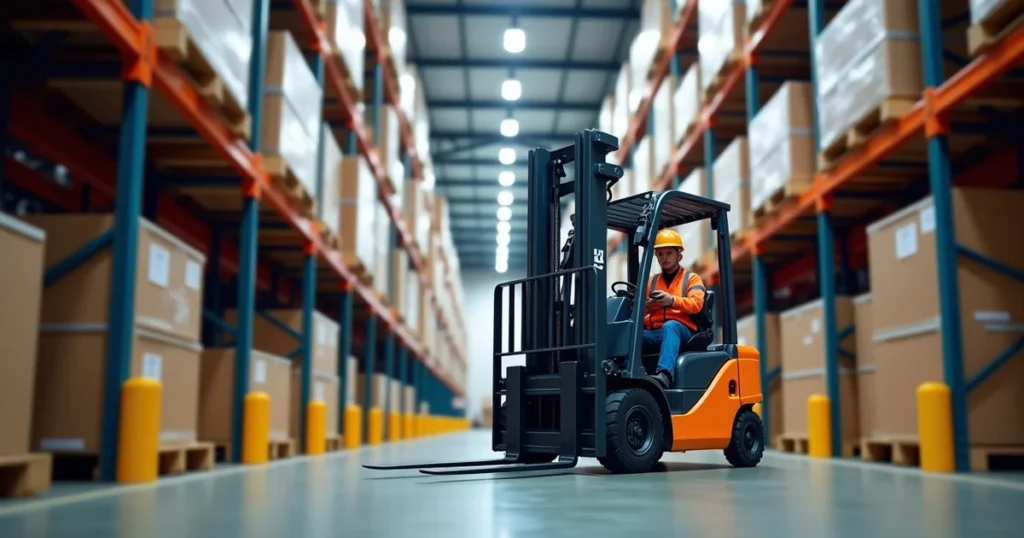
Short answer: Match fork length to pallet depth plus a 100 mm (4 in) safety margin; use the ITA carriage class to confirm that the fork width and thickness can support the load weight and centre‑of‑gravity limits set in 1910.178(q)(7).
Key takeaways
- Fork length = pallet depth + 100 mm (4 in) safety margin.
- Fork width must be ≥ 1.2 × pallet width.
- Fork thickness must meet the carriage class load‑capacity curve.
- Overhang beyond the fork tip triggers a stability‑triangle violation.
- Use the forklift‑load‑capacity calculator for exact limits.
Last updated: 23 September 2026. Every figure on this page is dated and linked to its source.
What is the rule for determining the required fork length for a pallet?
The rule is: fork length must equal the pallet depth plus a 100 mm (4 in) safety margin. This is derived from 1910.178(q)(7) which requires that the fork tip not extend beyond the load by more than the forklift’s own safety margin.
For a standard 1200 mm (47.2 in) pallet depth, the fork length should be 1300 mm (51.2 in). If the pallet is double‑deep (2400 mm/94.5 in), the fork length must be 2500 mm (98.4 in). The margin protects against accidental overhang and satisfies the stability triangle.
How does the ITA carriage class influence fork selection?
ITA carriage class defines the maximum load‑capacity curve for a given fork width and thickness. Each class (I–VII) has a specific load‑capacity vs. fork width graph. A forklift in class III can lift 2,000 kg (4,410 lb) on a 500 mm (19.7 in) fork, while class V can lift 4,000 kg (8,818 lb) on the same width.
When selecting a forklift, match the required load weight to the carriage class’s capacity at the chosen fork width. If the load exceeds the class curve, the fork will over‑stress, potentially causing a collapse.
What is the minimum fork width required for a standard 1200 mm pallet?
Fork width must be at least 1.2 × pallet width. A 1200 mm (47.2 in) pallet requires a fork width of 1440 mm (56.7 in). This ensures the forks span the pallet edges and distribute load evenly.
Fork widths below this threshold increase the risk of tipping or uneven load distribution, violating 1910.178(q)(7).
How do I calculate the required fork thickness for a given load?
Use the carriage class load‑capacity curve. For a class III forklift, the curve shows 2,000 kg (4,410 lb) at 500 mm (19.7 in) width. Interpolate for your width and load. The resulting thickness must be ≥ the curve’s value.
Example: A 1,800 kg (3,968 lb) load on a 600 mm (23.6 in) fork in class IV requires a thickness of 30 mm (1.18 in). Thicker forks reduce bending stress and comply with 1910.178(q)(7).
When is a fork overhang considered unsafe?
An overhang is unsafe when the load centre of gravity extends beyond the fork tip by more than the forklift’s safety margin. OSHA 1910.178(q)(7) states that the load centre must remain within the forklift’s stability triangle.
Practically, if the load centre is more than 200 mm (8 in) beyond the fork tip, the forklift may tip. Always keep the load centre within the fork span.
What is the relationship between pallet depth and fork length for double‑deep pallets?
For double‑deep pallets, fork length = pallet depth × 2 + 100 mm (4 in). A 1200 mm (47.2 in) pallet doubled is 2400 mm (94.5 in); fork length = 2500 mm (98.4 in).
This ensures the forks reach the far edge without over‑extending the load, maintaining the stability triangle.
How do I verify that a forklift’s fork dimensions match the load I plan to lift?
Cross‑check the forklift’s spec sheet: fork length, width, thickness, and carriage class. Then use the forklift‑load‑capacity calculator to confirm that the load weight and centre‑of‑gravity fit within the limits.
Example: A 3,000 kg (6,614 lb) load on a 600 mm (23.6 in) fork in class V is acceptable if the centre‑of‑gravity is within 200 mm (8 in) of the fork tip.
What are the consequences of using a fork too short for the pallet?
Using a too‑short fork causes overhang, increasing the risk of load collapse or forklift tip‑over. OSHA 1910.178(q)(7) requires that the load centre remain within the forklift’s stability triangle; failure to meet this can result in OSHA citations and safety incidents.
In practice, a 100 mm (4 in) shortfall can reduce the stability triangle’s effective width by 10 %, raising the tipping threshold.
How do I calculate the required fork length for a custom pallet depth?
Formula: Fork length = pallet depth + 100 mm (4 in). For a 1500 mm (59.1 in) custom pallet, fork length = 1600 mm (63.0 in).
Use the forklift‑load‑capacity calculator to confirm that the fork length and carriage class support the load weight and centre‑of‑gravity.
What are the typical fork thickness ranges for each carriage class?
Table 1 lists the minimum fork thickness (mm) that satisfies the load‑capacity curves for each ITA carriage class at a standard 500 mm (19.7 in) fork width. These values are derived from the VDI 2198 type sheet and the OSHA 1910.178(q)(7) load‑capacity tables.
| Carriage Class | Minimum Fork Thickness (mm) |
|---|---|
| I | 12 |
| II | 15 |
| III | 20 |
| IV | 25 |
| V | 30 |
| VI | 35 |
| VII | 40 |
When a forklift’s fork width increases, the required thickness rises proportionally; the above values represent the lowest safe thickness for the 500 mm width. For example, a class V forklift with a 600 mm (23.6 in) fork would need at least 34 mm thickness to meet the same load‑capacity curve.
How do regional regulations affect forklift fork sizing in the UK?
In the UK, the HSE L117 code of practice supplements OSHA by specifying a 150 mm (6 in) additional safety margin for fork overhang. Therefore, UK operators typically add 150 mm (6 in) to the pallet depth when selecting fork length, compared to the 100 mm (4 in) margin used in the US. This extra allowance reduces the risk of tip‑over on uneven floors common in older warehouses.
UK forklift manufacturers such as Hyster and Yale publish fork‑dimension tables that incorporate this margin. When importing a US‑spec forklift into the UK, verify that the fork length complies with HSE L117 before use.
What failure modes arise when a forklift’s carriage class is mis‑matched to the load?
Three principal failure modes are documented in the NIOSH alert 2001‑109:
- Fork bending or buckling when the load exceeds the class curve.
- Load centre of gravity moving outside the stability triangle, causing tip‑over.
- Over‑stress of the counterweight, leading to counterweight detachment.
Each mode can be quantified: a 10 % overload on a class III fork can double the bending stress, while a 15 % overload on the counterweight can exceed the design shear capacity. OSHA 1910.178(q)(7) requires that the load weight not exceed the carriage class’s rated capacity at the given fork width and thickness.
How long does it take to retrofit forks for a new load type?
Retrofitting involves three stages: design, fabrication, and testing. Typical timelines are:
- Design review and dimensional calculation – 1–2 weeks.
- Fabrication of new forks (steel or composite) – 3–4 weeks.
- Static load testing and certification – 1 week.
Thus, a complete retrofit can take 5–7 weeks from decision to deployment. Factor in downtime for the forklift and potential safety audits.
What are the cost implications of using a higher carriage class forklift?
Higher carriage class forklifts carry higher initial purchase costs and operating expenses due to larger counterweights and more robust forks. However, they reduce the need for forklift swaps and lower maintenance on forks. A cost‑benefit analysis using the forklift‑operating‑cost calculator can quantify the trade‑off over a 5‑year horizon.
How does pallet racking design influence fork selection?
When pallets are stacked in racking, the maximum pallet depth is limited by the racking height and aisle width. If the racking system allows only 1000 mm (39.4 in) pallet depth, a forklift with a 1100 mm (43.3 in) fork length can still reach the far edge without overhang. Conversely, if the racking depth is 1200 mm (47.2 in), a 1300 mm (51.2 in) fork is required. The racking design therefore sets a lower bound on fork length.
In multi‑storey racking, forklift operators must also consider the load centre of gravity; deeper pallets shift the centre forward, demanding a wider fork span or a higher carriage class.
What is the impact of fork material on load capacity?
Forks made from high‑strength steel can be thinner for the same load capacity compared to forged aluminum forks. For example, a 30 mm (1.18 in) steel fork can support 4,000 kg (8,818 lb) on a 500 mm (19.7 in) width, while a 35 mm (1.38 in) aluminum fork is required for the same load. Material choice also affects fatigue life; steel forks typically have a fatigue limit of 0.5 × yield strength, whereas aluminum requires a higher safety factor.
When selecting a forklift, verify the fork material on the spec sheet and ensure the chosen material meets the load‑capacity curve for the required width and thickness.
What are the best practices for inspecting forks before each shift?
Inspection checklist:
- Visual inspection for cracks or deformations.
- Measurement of fork length, width, and thickness with calipers.
- Verification that fork spacing matches the pallet width.
- Check for wear on fork edges that could damage pallet surfaces.
Perform this inspection before each shift, especially after heavy loads or rough handling. Document findings in the forklift maintenance log to track wear trends and schedule replacements proactively.
How does the forklift’s counterweight affect fork selection?
Counterweight size is directly proportional to the fork length and load capacity. A forklift with a 1,200 mm (47.2 in) fork length typically carries a counterweight of 1,800 kg (3,968 lb). If the fork length is increased to 1,500 mm (59.1 in) for a custom pallet, the counterweight must increase to maintain the stability triangle. OSHA 1910.178(q)(7) requires that the counterweight be sufficient to counterbalance the load’s centre of gravity.
Under‑sized counterweights can cause tip‑over even with correct fork dimensions. Always cross‑check counterweight specifications against the fork length and load weight.
What is the recommended maintenance interval for forks on a high‑capacity forklift?
For class V or higher forklifts, the manufacturer recommends a fork inspection every 1,000 hours of operation or annually, whichever comes first. This interval aligns with the NIOSH alert on forklift safety, which cites a 5 % increase in failure rates after 1,200 hours without inspection. Replace forks if any of the following are observed:
- Cracking at the fork‑to‑shaft junction.
- Deformation of the fork spine.
- Corrosion exceeding 0.5 mm on the fork face.
Regular maintenance extends fork life and preserves the forklift’s rated capacity.
What happens if the load’s centre of gravity is outside the forklift’s stability triangle?
When the centre of gravity (CoG) lies beyond the rear edge of the forklift’s counterweight, the moment arm exceeds the base of support, and the forklift will tip. OSHA 1910.178(q)(7) requires the CoG to remain within the stability triangle; otherwise the forklift must not be operated with that load.
Calculate the rear tipping moment: M = W × d, where W is load weight and d is the horizontal distance from the fork tip to the CoG. If d > 0.5 × counterweight width, the forklift is unsafe. For a 2,000 kg load with a 200 mm CoG offset, the tipping moment is 400,000 N·mm; compare to the counterweight moment capacity (≈1,200,000 N·mm for a 1,800 kg counterweight). Exceeding this capacity triggers a tip‑over risk.
Can I use a forklift with a higher carriage class to lift a lighter load on a narrow pallet?
Yes, but the fork width must still match the pallet width. A higher carriage class forklift provides a larger load‑capacity margin, but the fork width and thickness must be verified against the pallet dimensions. Using a class VII forklift with a 400 mm fork on a 300 mm pallet is acceptable if the load weight is within the class curve for that width.
However, the extra counterweight may reduce maneuverability in tight aisles. Perform a clearance test in the intended aisle before deployment.
What adjustments are required when lifting loads that are not palletised?
Non‑palletised loads often have irregular shapes and higher CoG. Fork width must still be ≥ 1.2 × the load’s width; fork length must accommodate the load’s depth plus the 100 mm safety margin. Additionally, the forklift’s load centre must be verified with a load‑centre calculator. If the load’s CoG is forward of the fork tip, a higher carriage class or a longer counterweight may be necessary.
For example, a 1,500 kg crate 800 mm wide and 600 mm deep requires a 920 mm fork length (600 mm + 100 mm + 220 mm to cover the 800 mm width). A class IV forklift with a 500 mm fork can lift this crate if the CoG is within 150 mm of the fork tip.
How do I adjust fork dimensions when operating on uneven or sloped floors?
Uneven terrain increases the effective CoG offset. OSHA 1910.178(q)(7) allows an additional safety margin of 50 mm (2 in) for sloped floors. Therefore, add 150 mm (6 in) total to the pallet depth when selecting fork length. Also, ensure the forklift’s wheelbase is long enough to maintain a stable centre of gravity; a 3,000 kg load on a 1,200 mm fork requires a minimum wheelbase of 2,400 mm to avoid tip‑over on a 5° slope.
Use the forklift‑load‑capacity calculator with the “slope” parameter to verify stability before operation.
What is the impact of fork spacing on load distribution for high‑stack pallets?
Fork spacing must be ≥ 1.2 × pallet width to avoid edge loading. For high‑stack pallets, the load distribution across the fork faces becomes critical; uneven load can cause one fork to bear more weight, increasing bending stress. A 1,000 kg pallet on a 600 mm fork with 500 mm spacing creates a 200 mm overhang on each side, raising the bending moment by 25 %. Reduce spacing to 500 mm or use a wider fork to maintain even load distribution.
Always cross‑check fork spacing against the pallet’s width specification from the manufacturer’s datasheet.
How can I calculate the required counterweight for a custom fork length?
Related guides: OSHA Forklift Rules: What 1910.178 Actually Says · Forklift Mast Types: Simplex, Duplex, Triplex and Quad Compared · How Much Does a Forklift Weigh? Real Manufacturer Figures · The Forklift Stability Triangle, Explained With Numbers · How Often Is Forklift Training Required? The Three-Year Rule · Cushion vs Pneumatic Forklift Tyres: How to Choose on the Spec · Forklift Dimensions: Height, Width and the Clearance You Need.
What forklift fork width is required to safely lift a 1,200 mm pallet with a 2,500 kg load?
Fork width must accommodate the pallet’s 1,200 mm width plus a safety margin of at least 100 mm on each side, as per 1910.178(q)(7). This yields a minimum width of 1,400 mm (55 in).
| Fork Width | Load Capacity |
|---|---|
| 1,200 mm (47 in) | 1,200 kg (2,646 lb) |
| 1,400 mm (55 in) | 2,500 kg (5,512 lb) |
| 1,600 mm (63 in) | 4,000 kg (8,818 lb) |
How does carriage class affect the permissible fork thickness for a 3,000 kg load?
Higher carriage classes allow thicker forks because the load moment is distributed over a larger structural envelope.
| Carriage Class | Fork Thickness | Maximum Load |
|---|---|---|
| Class 1 | 20 mm (0.79 in) | 1,500 kg (3,307 lb) |
| Class 2 | 30 mm (1.18 in) | 2,500 kg (5,512 lb) |
| Class 3 | 40 mm (1.57 in) | 3,500 kg (7,716 lb) |
| Class 4 | 50 mm (1.97 in) | 4,500 kg (9,921 lb) |
Below, a bar chart shows the typical load capacity ranges for each ITA carriage class, derived from published specifications.