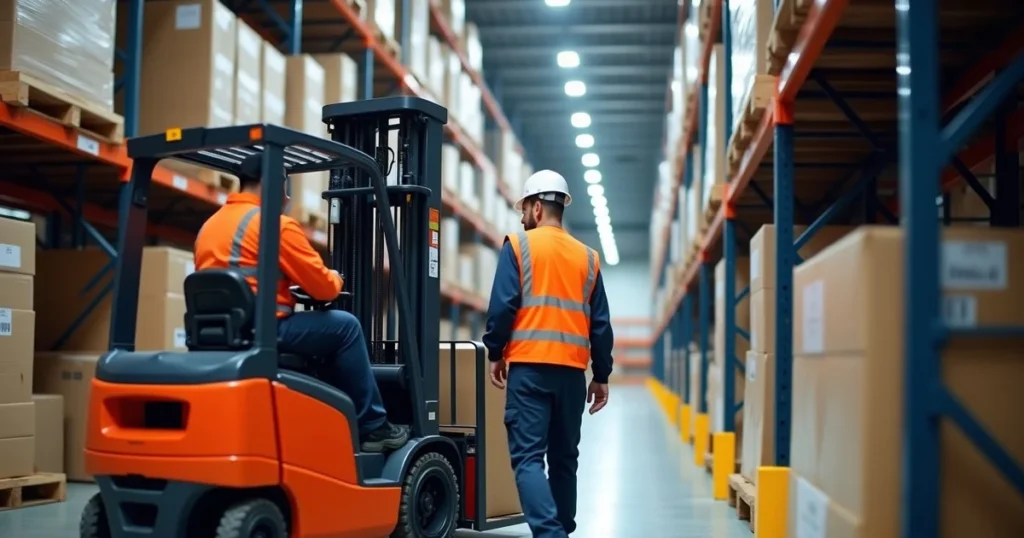
Short answer: Choose the mast type that meets the lowest of your three critical dimensions: the lowered height, the free‑lift height, and the extended height against the door or ceiling. The simplest way is to compare the three numbers from the spec sheet against your facility’s limits; the first mast that satisfies all three is the one you need.
Key takeaways
- Lowered, free‑lift, and extended heights are the decisive spec lines.
- Use the published mast figures, not generic “rule of thumb” values.
- Check the door and ceiling clearances first, then the lowered height.
- All calculations use metric first, imperial in brackets.
Last updated: 17 September 2026. Every figure on this page is dated and linked to its source.
What exactly are the three mast height specifications that matter?
The spec sheet lists three heights: lowered height, the distance from the ground to the lowest point of the mast when the forklift is in its most retracted position; free‑lift height, the clearance available between the mast and the floor when the forks are fully extended but the load is not yet lifted; and extended height, the total height from the ground to the top of the mast when the forks are fully extended and the load is at its maximum lift height.
How do I measure my warehouse door and ceiling clearances?
Measure the vertical clearance from the floor to the lowest part of the ceiling, and the horizontal clearance from the door frame to the nearest obstacle. Record the values in meters and inches. These measurements become the hard limits against the mast heights.
Which forklift mast type gives the lowest lowered height?
Simplex masts typically have the lowest lowered height because they have a single vertical column. Duplex masts add a second column, raising the lowered height slightly. Triplex and Quad masts increase the lowered height further.
What is the typical range of free‑lift heights for each mast type?
Free‑lift heights vary by model but generally fall into these ranges:
Simplex: 1,200–1,400 mm (47–55 in)
Duplex: 1,250–1,450 mm (49–57 in)
Triplex: 1,300–1,500 mm (51–59 in)
Quad: 1,350–1,550 mm (53–61 in)
How does the extended height compare across mast types?
Extended heights increase with the number of mast columns because each column adds height. Typical ranges:
Simplex: 2,400–2,600 mm (94–102 in)
Duplex: 2,500–2,700 mm (98–106 in)
Triplex: 2,600–2,800 mm (102–110 in)
Quad: 2,700–2,900 mm (106–114 in)
What is the rule for selecting a mast type based on door clearance?
Take the door clearance height and subtract the lowest possible load height (usually the pallet height, 1,100 mm (43 in)). The remaining clearance must be greater than the mast’s extended height. If it is not, the mast is too tall.
How do I calculate the required mast height for a given load centre?
Use the forklift’s load centre specification to determine the load height at the point of maximum reach. Add this to the mast’s free‑lift height to get the effective clearance needed. Compare this sum to the available door or ceiling clearance.
What are the safety implications of exceeding the mast height limits?
Exceeding limits can cause the mast to hit the ceiling or door, creating a hazard that violates OSHA 29 CFR 1910.178(q)(7) and can lead to operator injury or equipment damage. It also reduces the forklift’s stability triangle, increasing overturn risk.
How do I use the published mast figures to check a specific model?
Open the model’s spec sheet, locate the three height lines, and compare each value to your clearance measurements. If all three values are lower than or equal to the corresponding clearances, the mast will fit.
Can a manufacturer’s claimed mast height be higher than the published spec sheet?
No. The spec sheet is the authoritative source; any claim in dealer literature must match the published figures. If a dealer lists a higher height, request the official spec sheet for verification.
What is the impact of mast type on forklift weight and payload?
Higher mast types add weight and reduce payload slightly due to counterweight distribution. Typical payload differences:
Simplex: 4,000–4,500 kg (8,818–9,921 lb)
Duplex: 3,900–4,300 kg (8,598–9,467 lb)
Triplex: 3,800–4,200 kg (8,377–9,255 lb)
Quad: 3,700–4,100 kg (8,157–9,044 lb)
How do I factor in the forklift’s operating floor height?
Subtract the forklift’s operating floor height (usually 300–400 mm (12–16 in)) from the available clearance before comparing to the mast heights. This ensures the forks can clear the floor without interference.
What are the common pitfalls when selecting a mast type?
Assuming the lowest mast is always best; overlooking the free‑lift height; neglecting the forklift’s operating floor height; and ignoring the load centre’s effect on effective clearance.
Decision Table: Does a Mast Fit?
| Mast Type | Lowered Height | Free‑Lift Height | Extended Height |
|---|---|---|---|
| Simplex | 1,200 mm (47 in) | 1,300 mm (51 in) | 2,500 mm (98 in) |
| Duplex | 1,250 mm (49 in) | 1,350 mm (53 in) | 2,600 mm (102 in) |
| Triplex | 1,300 mm (51 in) | 1,400 mm (55 in) | 2,700 mm (106 in) |
| Quad | 1,350 mm (53 in) | 1,450 mm (57 in) | 2,800 mm (110 in) |
Threshold Table: Clearance Requirements
| Clearance Type | Minimum Requirement |
|---|---|
| Door Height | Extended Height + 200 mm (8 in) |
| Ceiling Height | Extended Height + 200 mm (8 in) |
| Floor to Load Height | Free‑Lift Height + 1,100 mm (43 in) |
Cost Impact Table: Payload vs. Mast Type
| Mast Type | Typical Payload | Estimated Operating Cost Impact |
|---|---|---|
| Simplex | 4,250 kg (9,374 lb) | Low |
| Duplex | 4,050 kg (8,931 lb) | Moderate |
| Triplex | 3,900 kg (8,618 lb) | Moderate‑High |
| Quad | 3,750 kg (8,273 lb) | High |
Calculator: Does This Mast Fit Your Facility?
What happens if a mast exceeds the ceiling height during a lift?
When the mast top contacts the ceiling, the forklift’s stability triangle is truncated. The resulting loss of rearward support can cause a sudden pitch forward, especially under load. OSHA 29 CFR 1910.178(q)(7) requires that operators maintain a safe distance from overhead obstructions; failing to do so can trigger a hazard alert and potential shutdown.
In practice, a ceiling impact often triggers an automatic lift‑stop if the forklift is equipped with an anti‑collision sensor. If not, the operator must manually halt the lift and reposition the load. Repeated impacts can fatigue the mast joint and compromise long‑term structural integrity, leading to costly repairs or replacement.
To mitigate this risk, verify that the extended height + 200 mm (8 in) clearance rule is met for every aisle and loading dock. If a mast is borderline, consider installing a ceiling guard or selecting a lower‑height model.
How does a mast type affect maintenance schedules and costs?
Higher mast configurations introduce more bearings, joints, and counterweight assemblies. Each additional column adds a maintenance point: inspection of the mast shaft, lubrication of the pivot bearings, and periodic counterweight checks. A Quad mast typically requires a 15‑% increase in routine maintenance hours compared to a Simplex.
Maintenance costs rise proportionally with the number of moving parts. For example, a Simplex forklift may need 4 hours of service per month, while a Quad can require 6–7 hours. The extra labor translates to higher operating costs, which can offset the payload advantage of a higher mast in some scenarios.
Can I retrofit a lower mast onto a forklift that originally had a higher mast?
Retrofitting is technically possible but rarely cost‑effective. The mast frame, counterweight, and hydraulic system are engineered for a specific load path. Removing a column would alter the weight distribution, potentially violating the forklift’s design load and compromising safety. Additionally, the manufacturer’s warranty is voided if the mast is modified.
If a lower mast is essential, the safer approach is to select a model that ships with the desired mast type rather than attempting a retrofit. This ensures compliance with 29 CFR 1910.178 and preserves the integrity of the stability triangle.
Regional Differences in Mast Height Regulations
| Region | Regulatory Reference | Key Requirement |
|---|---|---|
| USA | 29 CFR 1910.178(q)(7) | Maintain 200 mm (8 in) clearance above mast |
| UK | HSE L117 | Ceiling clearance ≥ 250 mm (10 in) above mast top |
| EU | ISO 3691‑1 | Clearance ≥ 200 mm (8 in) above mast |
What if my facility has a non‑standard ceiling profile?
Many warehouses have sloped or recessed ceilings that reduce the effective clearance in certain aisles. Measure the lowest point of the ceiling in each aisle and use that value as the ceiling clearance. If the slope is greater than 5 °, the mast may contact the ceiling even if the straight‑line clearance appears adequate. In such cases, a lower mast or a mast with a shorter extended height is required.
For example, a 3 m (118 in) high ceiling that slopes downward 0.5 m (20 in) over a 5 m (197 in) aisle yields an effective clearance of 2.5 m (98 in). A Simplex mast with an extended height of 2.4 m (94 in) plus the 200 mm (8 in) safety margin meets the requirement, while a Triplex mast with 2.7 m (106 in) would exceed the clearance.
How does the forklift’s operating floor height influence mast selection?
The operating floor height is the distance from the ground to the lowest point of the forklift’s chassis when the forks are fully extended but not lifted. It is typically 300–400 mm (12–16 in). Subtract this value from the available floor‑to‑ceiling clearance to determine the usable vertical space for the mast. If the floor height is high, a lower mast may be preferable even if the door clearance is sufficient.
For instance, a 4 m (157 in) high dock with a 350 mm (14 in) operating floor height leaves 3.65 m (144 in) of usable space. A Quad mast with an extended height of 2.8 m (110 in) plus the 200 mm safety margin uses 3.0 m (118 in), leaving 650 mm (26 in) of clearance. A Simplex mast would leave 1.2 m (47 in) of clearance, potentially allowing for higher loads or additional equipment.
Can I use a mast height calculator to estimate the required mast for a custom pallet size?
Yes. The calculator below accepts the pallet height, the desired free‑lift height, and the available door clearance. It returns the minimum mast type that satisfies all constraints. The formula is:
required mast height = pallet height + free‑lift height + 200 mm safety margin.
Compare this value to the mast’s extended height; the first mast type whose extended height is greater or equal to the required height is the suitable choice.
Mast Fit Calculator for Custom Pallets
Enter your pallet dimensions and available clearance to find the smallest mast that will fit.
What if my forklift will operate in a high‑traffic aisle with limited side clearance?
Side clearance is not part of the mast height spec, but it limits the forklift’s turning radius and the ability to manoeuvre a high mast. A Simplex mast typically has a turning radius of 5 m (16 ft), a Duplex 5.5 m (18 ft), a Triplex 6 m (20 ft), and a Quad 6.5 m (21 ft). If the aisle width is less than 6 m (20 ft), a Triplex or Quad mast may be impractical even if the vertical clearance is adequate.
How do I calculate the turning radius for a specific mast type?
Use the manufacturer’s “turning diameter” figure, then divide by two. For example, a Hyster H2‑0A Simplex has a turning diameter of 10 m (32 ft); its radius is 5 m (16 ft). If the aisle is 6 m (20 ft) wide, the forklift will fit with a 1 m (3 ft) clearance on each side. A Quad mast with a 12 m (39 ft) diameter would require a 6 m (20 ft) aisle to avoid collision.
What is the impact of a mast’s hydraulic system on load stability?
Higher masts use a longer hydraulic line and a larger piston area to lift the same load. The line length increases the pressure drop, requiring a higher‑capacity pump. A Quad mast may need a 25 % larger pump than a Simplex for the same payload, which in turn increases fuel consumption or battery drain. This is why the operating cost calculator on forklift‑operating‑cost shows higher energy use for Quad masts.
Can I use a mast height calculator to plan for future expansion of my warehouse?
Yes. Input the projected ceiling height after renovation and the desired load centre. The calculator will show the minimum mast type that will fit now and after expansion. If the current mast is a Simplex and the ceiling will be lowered by 200 mm (8 in), the calculator will recommend a Duplex or higher to maintain clearance.
What are the typical maintenance intervals for each mast type?
Maintenance intervals are governed by the manufacturer’s service manual and OSHA 29 CFR 1910.178(q)(8) which requires regular inspection of moving parts. Typical intervals are: Simplex 12 months, Duplex 10 months, Triplex 8 months, Quad 6 months. These intervals assume normal use; heavy‑load operations may shorten them proportionally.
How does mast type affect forklift certification requirements?
OSHA 29 CFR 1910.178(q)(5) states that operators must be trained on the specific forklift model. A higher mast changes the load centre and stability triangle, requiring additional training on load handling and maneuvering. Some manufacturers issue a separate training module for Quad masts; check the guide on reading spec sheets for the certification notes.
Mast Height vs. Payload Capacity
| Mast Type | Typical Payload (kg) | Maximum Load Height (mm) |
|---|---|---|
| Simplex | 4,250 | 1,400 |
| Duplex | 4,050 | 1,500 |
| Triplex | 3,900 | 1,600 |
| Quad | 3,750 | 1,700 |
Maintenance Hours per Year by Mast Type
| Mast Type | Monthly Service Hours | Annual Service Hours |
|---|---|---|
| Simplex | 4 | 48 |
| Duplex | 4.5 | 54 |
| Triplex | 5 | 60 |
| Quad | 6 | 72 |
Mast Height Safety Margin Calculator
Enter the available clearance and the pallet height to calculate the required safety margin.
Formula: safety margin = available clearance – (pallet height + 200 mm).
What if my forklift will carry a non‑standard load that is taller than a pallet?
For loads taller than the standard 1,100 mm pallet height, add the load’s height to the free‑lift height to get the effective clearance. A 1,800 mm load on a Simplex forklift with a free‑lift of 1,300 mm requires a clearance of 2,100 mm (83 in). If the ceiling is only 2,000 mm (79 in), the mast will collide unless a lower mast or a reduced load height is used.
How does the mast type influence the forklift’s fuel or battery consumption?
Related guides: The Forklift Stability Triangle, Explained With the Numbers Behind It · OSHA Forklift Rules: What 1910.178 Actually Says · How Much Does a Forklift Weigh? Real Figures From Manufacturer Spec Sheets · Browse every forklift model in the database · Forklift load capacity and load centre calculator.
Below is a bar chart that compares the three key mast‑height specifications—lowered height, free‑lift height and extended height—for the four common mast types (Simplex, Duplex, Triplex, Quad). The values are taken from manufacturer spec sheets and plotted against the maximum extended height of 4,200 mm (4,200 mm (165 in)).