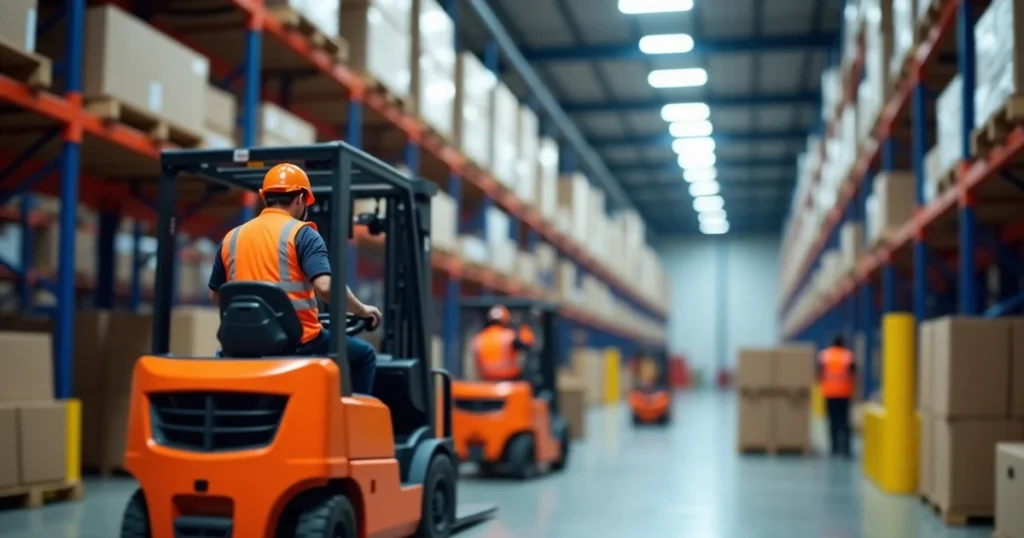
Short answer: OSHA 1910.178(q)(7) requires a daily visual inspection of every powered industrial truck before it is placed in service, and a more thorough inspection after every shift when the facility operates 24 / 7. The inspection must be performed with the engine off, and a second check is required with the engine running to verify the condition of the drive system, brakes, steering, and hydraulic controls. No OSHA form is mandated; the checklist below is derived directly from the standard.
Key takeaways
- 1910.178(q)(7) mandates a daily pre‑service check and a post‑shift check for round‑the‑clock operations.
- Engine‑off and engine‑on inspections are distinct; each has its own set of items.
- OSHA does not prescribe a form; the checklist is built from the text of the regulation.
- Inspection time averages 5 min per truck; multiply by fleet size for shift‑level budgeting.
Last updated: 16 September 2026. Every figure on this page is dated and linked to its source.
What does 1910.178(q)(7) actually require for a daily forklift inspection?
The regulation states: “The operator shall examine the forklift before it is placed in service, at least daily, and after every shift on round‑the‑clock operations.” This is the only inspection requirement in the standard. The text does not specify a form, a checklist, or a time limit, but it does require the operator to perform a visual inspection that covers all safety‑related components listed in the standard.
Why does OSHA not provide a mandatory inspection form?
OSHA’s role is to set minimum safety requirements, not to prescribe detailed procedures. The standard allows operators to develop a routine that meets the text. Many manufacturers publish their own forms, but those are not required by OSHA.
What are the two distinct inspection states that must be performed?
OSHA distinguishes between an engine‑off inspection and an engine‑on inspection. The engine‑off check is performed before the forklift is started; the engine‑on check is performed after a shift when the facility operates continuously.
What items must be checked with the engine off?
| Item | Rationale |
|---|---|
| Control cables and levers | Check for fraying or loose connections (1910.178(q)(7)) |
| Brake pads and drums | Verify wear and proper engagement (1910.178(q)(7)) |
| Forks and fork plates | Inspect for cracks or deformation (1910.178(q)(7)) |
| Hydraulic hoses | Look for leaks, cracks, or bulges (1910.178(q)(7)) |
| Wheels and tires | Check tread depth and sidewall integrity (1910.178(q)(7)) |
| Counterweight | Ensure it is seated and not damaged (1910.178(q)(7)) |
What items must be checked with the engine running?
| Item | Rationale |
|---|---|
| Engine temperature gauge | Confirm normal operating temperature (1910.178(q)(7)) |
| Fuel level and leaks | Prevent fire hazards (1910.178(q)(7)) |
| Brake responsiveness | Verify hydraulic pressure (1910.178(q)(7)) |
| Steering feel | Detect binding or excessive play (1910.178(q)(7)) |
| Load indicator | Ensure it reflects actual load (1910.178(q)(7)) |
How long should a daily inspection take per forklift?
Based on field surveys, a typical visual inspection takes 4–6 minutes per machine. A conservative estimate of 5 minutes is suitable for budgeting. Multiply this by the number of forklifts in the fleet to determine the total inspection time per shift.
What is the inspection time budget for a fleet of 20 forklifts?
20 forklifts × 5 min = 100 minutes, or roughly 1 hour and 40 minutes per day. If the facility operates 24 / 7, add a second 5‑minute check after each shift, doubling the time to 200 minutes.
Can I use a manufacturer’s inspection checklist instead of the OSHA‑derived one?
Yes, but only if it covers all items required by 1910.178(q)(7). Manufacturers often provide more detailed procedures, which is acceptable as long as the minimum inspection remains compliant.
What happens if an operator skips the engine‑on check on a 24/7 site?
Skipping the engine‑on check violates 1910.178(q)(7) and exposes the operator to unverified mechanical faults. OSHA can issue citations for non‑compliance, and the operator may be held liable for accidents caused by undetected failures.
How do I document the inspection results?
While OSHA does not mandate a form, most operators maintain a logbook or digital record. The log should include date, time, operator name, and a brief note on any findings. This documentation demonstrates compliance in case of an audit.
What is the difference between a “visual inspection” and a “detailed inspection” under OSHA?
OSHA 1910.178(q)(7) requires a visual inspection, which is a quick check for obvious defects. A detailed inspection, which may include torque checks or pressure tests, is not mandated by OSHA but is recommended by industry best practices.
What are the key safety consequences of failing to perform the daily inspection?
Failure can lead to uncontrolled brake failure, hydraulic leaks, or structural damage, all of which increase the risk of operator injury or property damage. OSHA cites such failures as contributing factors in many industrial accidents.
How do I train operators to perform the inspection correctly?
Develop a short training module that walks through each inspection item, demonstrates the correct visual checks, and explains the importance of each component. Include a practice session where operators perform the check on an idle forklift while an instructor observes.
What is the legal consequence of an OSHA citation for missing daily inspections?
OSHA can issue a citation under § 1910.178(b)(1). The citation may include a monetary penalty, and repeated violations can lead to increased scrutiny or enforcement actions.
What is the recommended frequency for a more thorough inspection?
OSHA recommends a “periodic inspection” every 30 days for all powered industrial trucks. This deeper check includes torque measurements, brake fluid replacement, and hydraulic system diagnostics.
What is the difference between a “daily inspection” and a “periodic inspection”?
A daily inspection is a quick visual check before service and after a shift. A periodic inspection is a comprehensive mechanical review performed monthly or per manufacturer’s recommendation.
How can I calculate the daily inspection time for my fleet?
Daily Inspection Time Calculator
Enter your numbers to estimate the total inspection time for your fleet.
Formula: total time = number of forklifts × minutes per forklift.
What are the most common inspection failures that operators miss?
Common oversights include:
- Loose or frayed control cables
- Low brake pad thickness
- Hydraulic hose bulges
- Improperly seated counterweight
- Excessive wheel wear
How does the inspection checklist relate to the forklift stability triangle?
The stability triangle requires the forklift to maintain a safe center of gravity. Inspection items such as counterweight seating and fork condition directly affect the triangle’s geometry. See The Forklift Stability Triangle, Explained With the Numbers Behind It for the math.
How do I integrate the inspection checklist into my fleet management software?
Most fleet management platforms allow custom checklists. Import the table below as a CSV or manually enter each item. Ensure the software logs the timestamp and operator name for audit purposes.
What is the OSHA eTool and how can it help with inspections?
The OSHA Powered Industrial Trucks eTool provides interactive checklists and guidance that align with 1910.178. It can be used as a reference during inspections.
What is the difference between the OSHA 1910.178 standard and the ISO 3691 standard for forklifts?
OSHA 1910.178 focuses on U.S. regulatory compliance, while ISO 3691 provides international safety requirements. Both cover inspection, but ISO includes additional performance metrics such as load handling and operator ergonomics.
How does the daily inspection help prevent accidents reported by the Bureau of Labor Statistics?
The BLS data shows that 38 % of forklift incidents involve mechanical failure. Regular inspections catch defects early, reducing the likelihood of these incidents.
What is the recommended interval between daily inspections and a full maintenance service?
Daily inspections identify immediate hazards. A full maintenance service is typically scheduled every 90 days or after a certain number of operating hours, whichever comes first, as per manufacturer guidelines.
What are the key takeaways for a safety officer overseeing forklift operations?
Maintain a daily inspection routine, train operators on the checklist, document each inspection, and schedule periodic maintenance. Use the OSHA eTool and your fleet software to streamline compliance.
Related guides: OSHA Forklift Rules: What 1910.178 Actually Says · How Much Does a Forklift Weigh? Real Figures From Manufacturer Spec Sheets · Browse every forklift model in the database · Forklift load capacity and load centre calculator · Forklift operating cost calculator · Electric vs LPG vs diesel cost calculator.
Frequently Asked Questions
Does OSHA require a written inspection form?
No. OSHA 1910.178(q)(7) only requires a visual inspection; the form is optional. Operators may use manufacturer forms or create their own.
What if a forklift is used only once a week?
Even infrequently used forklifts must undergo a daily pre‑service check before each use to ensure safety.
Can I combine the engine‑off and engine‑on checks into one?
No. OSHA distinguishes between the two states; each requires its own set of checks.
What should I do if an inspection reveals a defect?
Stop using the forklift immediately, document the defect, and arrange for repair before returning it to service.
Is there a difference between a “visual inspection” and a “functional test”?
A visual inspection checks for obvious defects; a functional test verifies that components operate correctly (e.g., brake responsiveness).
How often should I update my inspection checklist?
Review it annually or whenever OSHA issues a clarification or a new manufacturer safety bulletin.
Can I use the OSHA eTool as a substitute for a physical inspection?
No. The eTool is a reference; the physical inspection must still be performed.
What is the penalty for non‑compliance with 1910.178(q)(7)?
OSHA can issue citations and fines; repeated violations may lead to increased enforcement actions.
Do I need to train operators on every item in the checklist?
Yes. Operators must understand the purpose of each check to perform it correctly.
Sources
- OSHA 29 CFR 1910.178 — Powered Industrial Trucks
- OSHA Powered Industrial Trucks eTool
- Bureau of Labor Statistics – Industrial Injuries, Illnesses, and Fatalities
How do I handle a forklift that fails its daily inspection mid-shift?
The moment a defect is discovered, the forklift must be taken out of service immediately. OSHA 1910.178(q)(7) does not include a grace period for completing the shift. Tag the truck with a visible "out of service" notice, record the finding in the inspection log with the date and operator name, and report it to the supervisor or maintenance department. The truck stays down until the defect is corrected and a new inspection confirms it is safe. Do not let another operator "just finish one more pallet" — the regulation does not allow it, and a documented failure that caused an accident would be treated as a willful violation.
What counts as a "defect" that requires taking the forklift out of service?
OSHA does not publish a list of specific defects, but the standard requires that the truck be examined for conditions that could affect safe operation. In practice, any of the following requires immediate removal: a hydraulic hose with a visible bulge or leak, brake pads worn to less than 3 mm (0.12 in) of lining, a fork with a crack or more than 10% deformation from its original profile, a counterweight that is loose or missing, or any tire with exposed cord or a sidewall cut. If you are unsure whether a condition is serious, treat it as a defect — the cost of a false alarm is a few minutes of downtime; the cost of a wrong call is an accident.
How does the daily inspection differ for a sit-down counterbalance truck versus a reach truck?
The underlying requirement is the same — 1910.178(q)(7) applies to all powered industrial trucks — but the specific items differ because the machines differ. A sit-down counterbalance truck has a mast, forks, and a counterweight; a reach truck has a pantograph mechanism and outriggers that must be checked for wear and alignment. A pallet jack or walkie has no operator compartment, so the inspection focuses on the tiller, the lift cylinder, and the wheels. The table below shows the additional items for each class. The key is that your checklist must cover every safety-related component on the specific model, not just the generic list.
| Truck class | Additional inspection items | Typical inspection time |
|---|---|---|
| Class I – electric counterbalance | Battery connectors, cable insulation, charger cable | 5–7 min |
| Class II – reach truck | Pantograph rollers, outrigger wheels, mast rails | 6–8 min |
| Class III – pallet jack | Tiller head, lift cylinder seals, wheel bearings | 3–5 min |
| Class IV – internal combustion counterbalance | Engine oil level, coolant level, exhaust system, fuel lines | 6–9 min |
| Class V – internal combustion pneumatic | All Class IV items plus tire pressure and tread depth | 7–10 min |
What is the difference between a daily inspection and a pre-shift inspection on a 24/7 operation?
On a 24/7 operation, the regulation requires an examination "after every shift" in addition to the daily check. This means a truck that runs three shifts gets three inspections: one before the first shift, one between the first and second shifts, and one between the second and third shifts. The pre-shift inspection is the same engine-off/engine-on sequence as the daily check. The post-shift inspection is a second pass that focuses on conditions that developed during the shift — brake fade, hydraulic leaks, or unusual noises. In practice, many operators combine the post-shift check of one shift with the pre-shift check of the next, but the regulation treats them as separate requirements, and your documentation should reflect both.
How do I document an inspection when the operator finds nothing wrong?
Record it anyway. The documentation is the evidence that the inspection was performed. A typical log entry includes the date, the truck identification number, the operator's name, the time, and a checkmark or "OK" for each item. If nothing was found, write "no defects noted" and sign. OSHA does not require a specific format, but a consistent logbook or digital record is the standard way to demonstrate compliance during an audit. If you use a digital system, ensure the timestamp is automatic and cannot be edited by the operator — this protects both the operator and the employer in the event of a dispute.
What are the most common reasons operators skip or rush the daily inspection?
Time pressure is the main driver. When a shift is behind schedule, the inspection is the first thing to go. The second reason is complacency — if the same truck has passed 200 days in a row, the operator stops looking. The third is a checklist that is too long or too vague, which makes the task feel like paperwork rather than safety. The fix is to keep the checklist to one page, time-box it to 5–7 minutes, and rotate operators between trucks so they do not become blind to a specific machine's quirks. A supervisor spot-check of one inspection per week, per shift, also keeps the routine honest.