Short answer
Forklifts are covered by 29 CFR 1910.178, “Powered industrial trucks”. The obligations people most often get wrong: a truck must be examined at least daily (and after every shift on round-the-clock operations), every operator’s performance must be re-evaluated at least once every three years, and there is no OSHA-issued licence — the employer certifies each operator by name, with the training date, the evaluation date and who did them.
Most of what circulates as “OSHA forklift rules” is a paraphrase of a paraphrase. This page quotes the standard itself, links each paragraph, and is explicit about the places where common advice is industry practice rather than regulation.
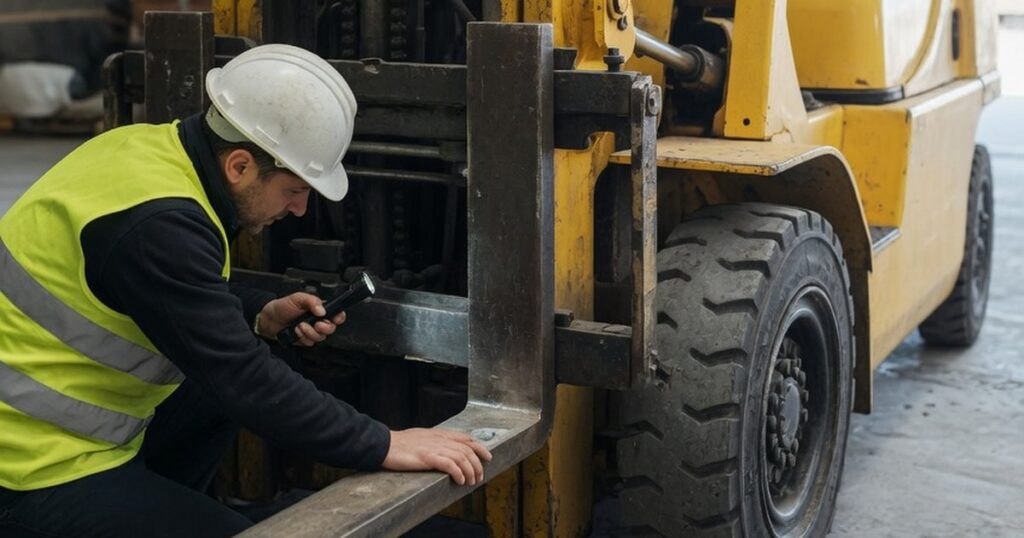
Inspections: at least daily, and after every shift
1910.178(q)(7) is short and unambiguous:
“Industrial trucks shall be examined before being placed in service, and shall not be placed in service if the examination shows any condition adversely affecting the safety of the vehicle. Such examination shall be made at least daily. Where industrial trucks are used on a round-the-clock basis, they shall be examined after each shift. Defects when found shall be immediately reported and corrected.”
Three things follow that people miss:
- Daily is a floor, not a schedule. Three shifts means three examinations, not one.
- A failed check takes the truck out of service. The standard does not say “note it and carry on”; it says the truck shall not be placed in service.
- OSHA does not publish a mandatory checklist form. The paragraph specifies the examination, not the paperwork. Any checklist that covers the truck’s safety-critical condition satisfies it; a form with a company logo has no special standing.
What a pre-shift check has to cover
Working from what the standard requires elsewhere — legible nameplates under (a)(6), working brakes and controls, no condition adversely affecting safety under (q)(7) — a defensible check covers at minimum:
| Engine off | Engine running |
|---|---|
| Tyres: condition, pressure on pneumatics, chunking or flat spots | Service brake and parking brake |
| Forks: cracks, heel wear, bent tips, locking pins | Steering, including free play |
| Mast, chains and hoses: wear, slack, leaks | Lift, lower and tilt through full travel |
| Data plate and warning decals present and legible | Horn, lights and any reversing alarm |
| Fluid levels and visible leaks | Unusual noise, smoke or smell |
| Overhead guard and load backrest secure | Seat belt and operator presence system |
| LPG cylinder and connections, or battery, cables and connector | Gauges and warning lights |
Training: what OSHA requires, and what it does not
Paragraph (l) covers operator training. The headline points:
- Training and evaluation before operating. Formal instruction plus practical training plus an evaluation of performance in the workplace.
- Refresher training on trigger events, under (l)(4)(ii): the operator has been observed operating unsafely; has been involved in an accident or near-miss; has received an evaluation showing they are not operating safely; is assigned a different type of truck; or workplace conditions change in a way that could affect safe operation.
- Re-evaluation every three years, under (l)(4)(iii): “An evaluation of each powered industrial truck operator’s performance shall be conducted at least once every three years.”
- Certification by the employer, under (l)(6): the certification “shall include the name of the operator, the date of the training, the date of the evaluation, and the identity of the person(s) performing the training or evaluation.”
Two widely repeated claims that the standard does not support:
- “OSHA issues a forklift licence.” It does not. There is no OSHA card, number or registry. The employer certifies; the record lives with the employer.
- “Online certification is enough.” Online material can deliver the formal instruction part. It cannot deliver practical training on the truck, or the evaluation of the operator’s performance in your workplace, both of which the standard requires.
Data plates, capacity and attachments
This is the part that connects the rules to the specification sheet, and it is where a lot of quiet non-compliance sits.
- 1910.178(a)(4): “Modifications and additions which affect capacity and safe operation shall not be performed by the customer or user without manufacturers prior written approval. Capacity, operation, and maintenance instruction plates, tags, or decals shall be changed accordingly.”
- 1910.178(a)(5): where a truck carries front-end attachments other than factory-installed ones, “the user shall request that the truck be marked to identify the attachments and show the approximate weight of the truck and attachment combination at maximum elevation with load laterally centered.”
- 1910.178(a)(6): “The user shall see that all nameplates and markings are in place and are maintained in a legible condition.”
- 1910.178(o)(2): “Only loads within the rated capacity of the truck shall be handled.”
- 1910.178(o)(4): trucks with attachments “shall be operated as partially loaded trucks when not handling a load.”
In practice: bolting a clamp onto a truck without getting the plate amended is a violation of (a)(4) and (a)(5) at the same time, and it also means nobody on the floor knows the real capacity. If you need to work out what an attachment costs you before the plate comes back, our load capacity calculator deducts both the attachment weight and the lost load centre.
Travelling, parking and pedestrians
| Paragraph | What it requires |
|---|---|
| (m)(2) | Nobody may stand or pass under the elevated portion of any truck, loaded or empty. |
| (m)(3) | No unauthorised riders. Where riding is authorised, a safe place to ride must be provided. |
| (m)(5)(i)–(ii) | Left unattended: forks fully lowered, controls neutralised, power off, brakes set, wheels blocked on an incline. “Unattended” means the operator is 25 ft or more away, or out of sight of the truck. |
| (n)(1) | Observe traffic rules and plant speed limits; keep approximately three truck lengths from the truck ahead. |
| (n)(7)(i) | On grades over 10%, loaded trucks are driven with the load upgrade. |
| (n)(7)(iii) | On all grades the load is tilted back and “raised only as far as necessary to clear the road surface.” |
| (n)(8) | Speed must allow the truck to be stopped safely. |
How high should a load be carried? What the rule really says
You will see “four to six inches off the floor” quoted everywhere as if it were regulation. It is not in 1910.178. What the standard says about travel height is (n)(7)(iii), and it applies to grades: the load is tilted back and raised only as far as necessary to clear the road surface. The four-to-six-inch figure is sensible industry practice that follows from the same principle — low enough to keep the combined centre of gravity down, high enough to clear the floor and any dock plate. Treat it as good practice, and treat “raised only as far as necessary” as the rule.
Frequently asked questions
How often is forklift training required?
There is no fixed renewal interval for training itself. What is fixed is the evaluation: 1910.178(l)(4)(iii) requires each operator’s performance to be evaluated at least once every three years. Refresher training is additionally required whenever one of the trigger events in (l)(4)(ii) occurs — unsafe operation, an accident or near-miss, a poor evaluation, a different type of truck, or changed workplace conditions.
Does OSHA require a daily forklift inspection?
Yes. 1910.178(q)(7) requires examination before the truck is placed in service and at least daily, and after each shift where trucks are used round the clock. Any defect found must be reported and corrected immediately, and a truck showing a condition that affects its safety must not be put into service.
Is an online forklift certification valid?
Only as part of the process. The standard requires formal instruction, practical training and an evaluation of the operator’s performance in the workplace where the truck will be used. An online course can cover the first of those. The employer still has to certify the operator by name, with the dates and the identity of whoever trained and evaluated them.
Who is responsible for forklift certification, the operator or the employer?
The employer. 1910.178(l)(6) places the certification duty on the employer, and the record must name the operator, the training date, the evaluation date and the person who carried them out. Operators do not hold an OSHA-issued licence.
Can a forklift be modified or have counterweight added?
Not without the manufacturer’s prior written approval. 1910.178(a)(4) covers modifications affecting capacity or safe operation and requires the capacity plate to be changed accordingly, and (q)(6) separately prohibits additional counterweighting unless the manufacturer approves it.
Does OSHA say how fast a forklift may travel?
Not as a number. 1910.178(n)(1) requires authorised plant speed limits to be observed, and (n)(8) requires a speed that allows the truck to be stopped safely under the conditions. Setting the actual limit is the employer’s job.
Sources
- 29 CFR 1910.178 — Powered industrial trucks, the full text of the standard. All quotations on this page are from it.
- OSHA Powered Industrial Trucks (Forklift) eTool, OSHA’s own non-binding guidance on types, operation and load handling.
This page summarises a United States federal standard and is not legal advice. State plans may impose additional requirements, and workplaces outside the US are governed by their own rules.