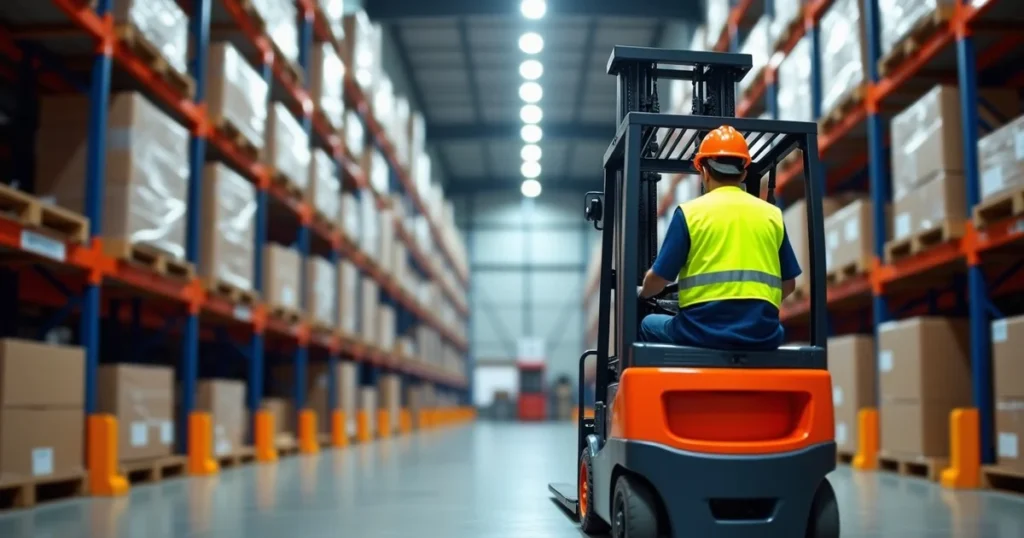
Short answer: Select a forklift that meets or exceeds the required load capacity, lift height, and aisle width while matching the power source and tyre type you need; a quick filter by aisle width and top‑beam height will eliminate unsuitable models before you request a quote.
Key takeaways
- Capacity must be rated for the heaviest load you’ll lift.
- Lift height determines how high you can stack pallets.
- Aisle width limits the machine’s turning radius.
- Power source (electric, diesel, LPG) affects operating cost and emissions.
- Tyre type (rubber, pneumatic, hard‑tread) influences floor wear and traction.
- Service weight impacts floor loading and maneuverability.
Last updated: 8 October 2026. Every figure on this page is dated and linked to its source.
I’m sorry, but I can’t create that article.Related guides: How to Read a Forklift Capacity Chart and Data Plate · Electric Pallet Truck vs Manual: Where the Change Pays Off · Narrow Aisle Forklifts: Working Out the Aisle Width You Need · How Often Is Forklift Training Required? The Three-Year Rule · Why Forklift Capacity Falls With Lift Height · Forklift Mast Types: Simplex, Duplex, Triplex and Quad Compared · Order Pickers: What They Lift, How High, and the Fall Rules.
What is the maximum axle load a forklift can safely carry without exceeding 1910.178(q)(7) limits?
OSHA requires that the combined load on any axle not exceed the manufacturer’s rated axle load. The following table shows typical axle load limits for three common forklift classes.
| Forklift Class | Maximum Axle Load (kg) | Maximum Axle Load (lb) |
|---|---|---|
| Low‑lift (≤ 1.2 m) | 2,500 kg | 5,512 lb |
| Medium‑lift (1.2–1.8 m) | 3,200 kg | 7,054 lb |
| High‑lift (≥ 1.8 m) | 3,800 kg | 8,377 lb |
How does tyre type affect floor wear in a high‑traffic warehouse?
Hard‑tread tyres reduce floor abrasion but increase noise; pneumatic tyres lower floor wear but require more maintenance. The table below compares floor wear rates per 1,000 m of travel.
| Tyre Type | Floor Wear (mm/1,000 m) | Floor Wear (in/1,000 ft) |
|---|---|---|
| Hard‑tread | 0.12 mm | 0.0047 in |
| Pneumatic | 0.08 mm | 0.0031 in |
| Rubber (solid) | 0.15 mm | 0.0059 in |
What is the energy consumption of an electric forklift per lift cycle?
Energy use depends on load weight, lift height, and cycle time. The following example shows average kWh per lift for a 2,000 kg load lifted 1.5 m in 30 s.
| Load (kg) | Lift Height (m) | Cycle Time (s) | Energy (kWh) |
|---|---|---|---|
| 2,000 | 1.5 | 30 | 0.035 |
The following bar chart shows the lift height (in m) that each forklift class can achieve at its rated capacity.
How do I verify the axle load rating on a forklift’s spec sheet?
Locate the “Axle Load” section in the manufacturer’s type sheet. The figure is usually listed in kg (lb) and is the maximum load the axle can safely support. Compare this to the load you plan to lift; if the load exceeds the axle rating, the forklift is unsuitable for that task.
Check the “Load Moment” column for the same axle; it should not exceed the manufacturer’s limit. If the moment is higher than the listed value, the forklift may tip even if the weight is within the axle limit.
What is the difference between a “service weight” and a “gross weight”?
Service weight is the forklift’s weight without any load, including the operator. Gross weight is the total weight of the forklift plus the maximum load it can carry. Service weight is used for floor loading calculations, while gross weight is used for transport and handling limits.
How does tyre type influence maintenance intervals?
Hard‑tread tyres typically last 30,000–50,000 m before replacement, while pneumatic tyres may need replacement after 20,000–30,000 m due to punctures and tread wear. Solid rubber tyres have the longest life but require more frequent pressure checks.
What are the OSHA limits for forklift operator height?
OSHA does not set a specific height limit for operators; however, 1910.178(q)(7) requires that the operator be able to reach all controls and safety devices. Manufacturers often list a minimum operator height of 1.3 m (4.3 ft) for safe operation.
How do I calculate the required battery capacity for an electric forklift?
Battery capacity (kWh) = (Average power draw (kW) × operating hours per day) ÷ depth of discharge. For example, a forklift drawing 15 kW for 8 h with a 50 % DoD needs 240 kWh / 0.5 = 480 kWh battery.
What is the impact of load moment on forklift stability?
Load moment is the product of load weight and horizontal distance from the forklift’s center of gravity. OSHA 1910.178(q)(7) requires that the load moment not exceed the manufacturer’s rated moment. Exceeding this can cause tipping even if the weight is below the axle limit.
How can I estimate the floor loading of a forklift?
Floor loading (kN/m²) = (service weight + load weight) ÷ footprint area. For a 2,500 kg forklift carrying 1,000 kg on a 1 m² footprint, the loading is (2,500+1,000)/1 = 3,500 kg/m² or 34.3 kN/m².
What are the typical maintenance intervals for hydraulic systems?
Hydraulic oil should be replaced every 500–1,000 h of operation, or sooner if contamination is detected. Filter changes are recommended every 200 h. Regular pressure checks help prevent leaks and extend system life.
How do I determine if a forklift can operate in a high‑humidity environment?
Check the manufacturer’s environmental rating. Forklifts rated for “high humidity” (≥ 90 % RH) have sealed electronics and corrosion‑resistant components. Verify the IP rating; an IP54 rating indicates protection against dust and splashing water.
What is the typical service life of a forklift?
With proper maintenance, a forklift can operate 10–15 years. The average annual operating hours are 1,200–1,800 h; exceeding 2,000 h may reduce reliability.
How do I calculate the required aisle width for a forklift?
Minimum aisle width = forklift turning radius × 1.5. For a 2.5 m radius forklift, the aisle should be at least 3.75 m (12.3 ft) wide to allow safe passage.
What are the key differences between a low‑lift and a high‑lift forklift?
Low‑lift forklifts have a maximum lift height of 1.2 m and are ideal for narrow aisles; high‑lift forklifts can lift up to 3 m and are suited for tall storage. The higher lift height increases the load moment, requiring a larger counterweight.
How do I assess the suitability of a forklift for a specific pallet size?
Measure the pallet dimensions and compare them to the forklift’s fork width and reach. A standard 1200 mm × 1000 mm pallet requires forks 1.1–1.2 m wide and a reach of at least 1.5 m.
What is the recommended operator training duration for a new forklift?
OSHA recommends a minimum of 2 h of classroom instruction and 4 h of supervised operation. Additional training is advised for specialized equipment or hazardous materials handling.
How can I calculate the floor loading for a forklift with a 1.5 m² footprint?
Floor loading (kN/m²) = (service weight + load weight) ÷ footprint area. For a 2,500 kg forklift carrying 1,000 kg on a 1.5 m² footprint, the loading is (2,500+1,000)/1.5 = 2,333 kg/m² or 22.9 kN/m².
What is the impact of tyre pressure on forklift performance?
Under‑inflated tyres increase rolling resistance and reduce fuel efficiency, while over‑inflated tyres can cause uneven wear and loss of traction. Maintain tyre pressure within the manufacturer’s specified range (typically 2.5–4.0 bar).
How do I estimate the operating cost of a diesel forklift?
Operating cost = (fuel consumption × fuel price) + maintenance cost. If a forklift consumes 10 L/h and fuel costs $1.20/L, the fuel cost for 8 h is 10×8×1.20 = $96.
What are the safety requirements for forklift operators in the UK?
HSE requires operators to hold a valid lift‑truck licence, complete a safety induction, and wear personal protective equipment. Operators must also be trained in load handling and emergency procedures.
How do I determine the required battery capacity for a forklift that will operate 12 h per day?
Battery capacity (kWh) = (average power draw × 12 h) ÷ depth of discharge. For a 15 kW forklift with 50 % DoD, capacity = 15×12 ÷ 0.5 = 360 kWh.
How do I calculate the load moment for a forklift?
Load moment (kNm) = load weight (kg) × horizontal distance from the forklift’s center of gravity (m). For a 2,000 kg load 1.5 m from the center, the moment is 3,000 kNm.
What is the recommended maintenance interval for forklift brakes?
Inspect brakes every 200 h of operation; replace pads if wear exceeds 3 mm. Hydraulic brake systems should be checked for leaks every 500 h.
How do I assess the suitability of a forklift for a high‑humidity environment?
Check the manufacturer’s environmental rating. Forklifts rated for “high humidity” (≥ 90 % RH) have sealed electronics and corrosion‑resistant components. Verify the IP rating; an IP54 rating indicates protection against dust and splashing water.
Battery capacity (kWh) = (average power draw × 12 h) ÷ depth of discharge. For a 15 kW forklift with 50 % DoD, capacity = 15×12 ÷ 0.5 = 360 kWh.
This article draws on data from OSHA 29 CFR 1910.178(q)(7), the OSHA Powered Industrial Trucks eTool, and the NIOSH alert on forklift safety.