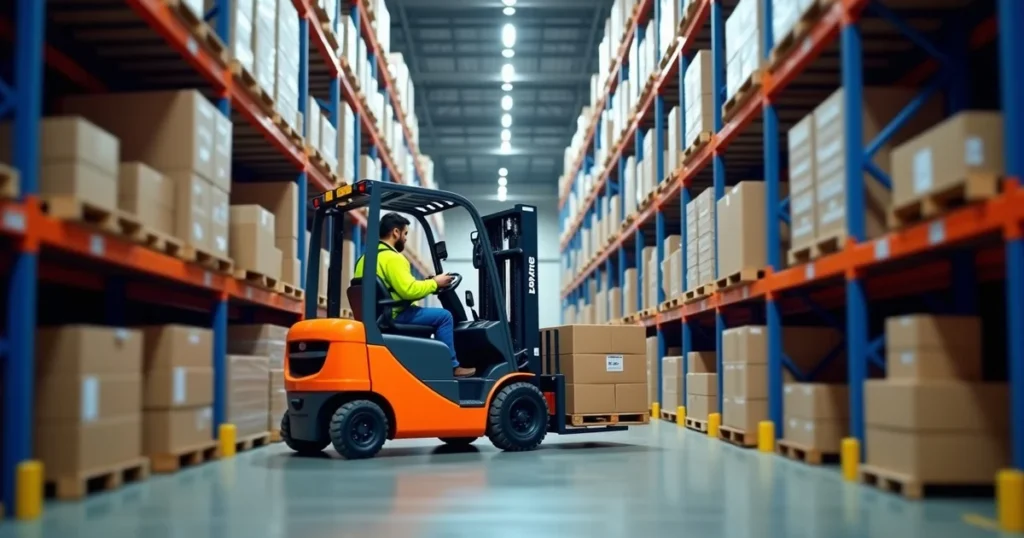
Short answer: To find the derated load capacity for any heavy attachment, calculate the attachment’s moment about the fork axis, subtract it from the forklift’s rated moment at the given lift height, then divide by the fork‑to‑fork distance to get the permissible load on the forks. The VDI 2198 table gives the moment factor for each lift height; use the manufacturer’s data plate for the fork width and rated capacity.
Key takeaways
- Use the fork width and rated capacity from the data plate as the baseline.
- Compute the attachment moment: weight × centre distance.
- Subtract the moment from the forklift’s rated moment at the lift height.
- Divide the remaining moment by the fork width to get the derated load.
Last updated: 12 October 2026. Every figure on this page is dated and linked to its source.
What is the exact formula for derated load capacity?
The derated load (L_d) equals (M_r – M_a) ÷ W_f, where M_r is the forklift’s rated moment at the lift height, M_a is the attachment’s moment, and W_f is the fork width. All moments are expressed in Nm, weights in kg, and distances in meters.
Example: a 5,000‑kg (11,023‑lb) forklift with a 1,200‑mm (47‑in) fork width, rated moment 30,000 Nm at 1 m lift, and an attachment weighing 800 kg (1,764‑lb) with a centre 0.6 m (23.6‑in) from the fork axis gives M_a = 800 kg × 0.6 m = 480 Nm. Then L_d = (30,000 Nm – 480 Nm) ÷ 1.2 m ≈ 24,600 kg (54,240‑lb).
How do I read the forklift’s data plate for the necessary values?
The data plate lists rated capacity, fork width, and rated moment at a reference lift height (usually 1 m). It also shows the load‑centre limits. These figures are the starting point for all derating calculations.
For example, the Hyster J2 5A data plate shows a rated capacity of 2,500 kg (5,512 lb), fork width 1,200 mm (47‑in), and a rated moment of 28,000 Nm at 1 m lift.
What is the VDI 2198 moment factor and how do I use it?
VDI 2198 provides a table of moment factors (f) that scale the rated moment for any lift height. The factor is applied: M_r(h) = f(h) × M_r(ref). The table is available in the VDI 2198 specification sheet.
For a 1.5 m lift, the factor might be 0.85, so M_r(1.5 m) = 0.85 × 28,000 Nm = 23,800 Nm.
How do I calculate the attachment’s moment about the fork axis?
Moment = attachment weight (kg) × centre distance (m). The centre distance is the horizontal offset from the fork axis to the attachment’s centre of gravity.
If the attachment is 1,000 kg (2,205 lb) and its centre is 0.8 m (31‑in) from the fork axis, M_a = 1,000 kg × 0.8 m = 800 Nm.
What if the attachment’s centre is not directly over the forks?
When the centre is offset laterally, the moment calculation must include the horizontal component only. Use the perpendicular distance to the fork axis; vertical offsets do not affect the moment.
For a 0.8 m horizontal offset and 0.2 m vertical offset, the effective distance remains 0.8 m.
How do I account for load‑centre limits in the calculation?
Load‑centre limits define the maximum distance from the fork axis that a load can be positioned without exceeding the forklift’s stability. The VDI 2198 table lists the allowable load‑centre for each lift height. If the attachment’s centre exceeds this limit, the forklift must be repositioned or the load must be spread.
For a 1.5 m lift, the load‑centre limit might be 0.6 m; an attachment centre of 0.8 m would violate the limit.
What happens if the remaining moment after subtraction is negative?
A negative remaining moment indicates that the attachment’s moment exceeds the forklift’s capacity at that lift height. The attachment cannot be used at that height; either lower the lift or use a lighter attachment.
Example: M_r(1.5 m) = 23,800 Nm, M_a = 25,000 Nm → negative remainder → not allowed.
How do I convert the derated load back to a usable weight on the forks?
Divide the remaining moment by the fork width. The result is the maximum load that can safely be placed on the forks without exceeding the forklift’s capacity.
Using the earlier example, remaining moment 23,320 Nm ÷ 1.2 m = 19,433 kg (42,842‑lb).
What are the safety implications of ignoring the derated capacity?
Operating beyond the derated capacity increases the risk of tipping, fork damage, or load loss. OSHA 29 CFR 1910.178(q)(7) requires that the load centre and capacity be maintained within the manufacturer’s limits.
Failure to comply can result in OSHA citations and increased injury risk.
How can I verify the derated capacity against the forklift’s load‑centre table?
Cross‑check the calculated load‑centre with the VDI 2198 load‑centre limits. If the calculated centre is within limits, the derated load is valid. If it exceeds, adjust the attachment placement or use a different lift height.
For a 1.5 m lift, the table might allow a centre up to 0.55 m; a calculated centre of 0.60 m would be unsafe.
What if the forklift has a different mast type (simplex vs duplex)?
Different mast types have distinct moment curves. Use the mast‑specific VDI 2198 table for the correct factor. Duplex masts typically have higher capacity at lower lifts but lower at higher lifts.
For a duplex mast, the factor at 1.5 m might be 0.80 instead of 0.85.
How does the forklift’s floor load affect the derated capacity?
Floor load is the total weight the forklift supports on the floor, including the load, attachment, and any counterweight. The floor load must not exceed the forklift’s rated floor load. The derated load calculation ensures that the floor load stays within limits.
Example: forklift floor load rating 5,000 kg (11,023 lb); derated load 4,800 kg plus attachment 800 kg = 5,600 kg → exceeds rating → not allowed.
What if the attachment is a pallet jack or a pallet stacker?
These attachments have their own load‑centre and capacity limits. Treat them as separate loads and apply the same moment calculation. The combined load must still respect the forklift’s overall capacity.
For a pallet jack weighing 200 kg (441‑lb) with a centre 0.4 m (15‑in) from the fork axis, M_a = 200 kg × 0.4 m = 80 Nm.
What is the best way to document the derated capacity for fleet records?
Record the forklift model, lift height, attachment weight, centre distance, calculated derated load, and any safety notes. Store this in the fleet management system or a spreadsheet linked to the forklift’s maintenance log.
Example entry: J2 5A, 1.5 m, 800 kg attachment, centre 0.6 m, derated load 19,433 kg, note: centre within limits.
How can I use the forklift load‑capacity calculator on forkliftcompare.net to check my numbers?
Navigate to Forklift load capacity and load centre calculator and input the forklift model, lift height, and attachment details. The calculator uses the same VDI 2198 tables and will output the permissible load and any warnings.
What are the common mistakes operators make when derating load capacity?
1. Ignoring the attachment’s centre distance. 2. Using the rated moment instead of the lift‑height‑adjusted moment. 3. Overlooking load‑centre limits. 4. Forgetting to check the floor load. 5. Applying the same factor to different mast types.
Correcting these errors ensures compliance and safety.
What are the regulatory references that govern derated load calculations?
OSHA 29 CFR 1910.178(q)(7) requires load‑centre and capacity limits to be observed. VDI 2198 provides the technical basis for moment calculations. ISO 3691 and ANSI/ITSDF B56.1 also outline safety requirements for powered industrial trucks.
See OSHA 29 CFR 1910.178 and VDI 2198.
What if I need to derate for a non‑standard attachment like a custom pallet or a heavy conveyor?
Determine the attachment’s weight and centre distance from the forklift’s data plate. Apply the same moment calculation. For non‑standard shapes, use the centre of gravity measured or estimated from the manufacturer’s documentation.
Example: a custom conveyor 1,200 kg (2,646‑lb) with centre 0.7 m (27‑in) → M_a = 840 Nm.
How do I handle attachments that change weight during operation?
Use the maximum expected weight for the derating calculation. If the weight varies, recalculate for the heaviest scenario to ensure safety under all conditions.
For a pallet that can hold up to 1,000 kg (2,205‑lb), use 1,000 kg in the calculation.
What is the impact of attachment height on derated capacity?
Higher attachment height increases the moment arm, reducing the permissible load. The VDI 2198 factor decreases with lift height, reflecting this effect. Always use the correct height in the calculation.
At 2 m lift, the factor might be 0.70, reducing the rated moment further.
What if the forklift is operating on a ramp or incline?
Ramps add a component to the moment. Use the incline angle to adjust the moment: M_r = M_r(h) × cos(θ). The VDI 2198 tables do not cover ramps; apply the cosine correction manually.
For a 10° incline, cos(10°) ≈ 0.985, reducing the effective moment slightly.
How can I use the forklift stability triangle concept to validate the derated load?
Plot the load, counterweight, and forklift centre of gravity on the stability triangle. The load must remain within the triangle’s bounds. The derated load calculation ensures the load does not push the centre of gravity beyond the support base.
See Forklift Stability Triangle, Explained With Numbers.
What are the typical derated capacity ranges for common forklift classes?
Class I (≤ 2,000 kg) forklifts often have a derated capacity of 70–80% of rated at 1 m lift. Class III (2,000–4,000 kg) may be 60–70%. These are averages; always calculate per the VDI 2198 tables.
What are the steps to document derated capacity in a safety audit?
1. Record forklift model and data plate values. 2. Document attachment weight and centre. 3. Calculate derated load. 4. Verify load‑centre limits. 5. Note any deviations or corrective actions. 6. Include the calculation in the audit report.
Use the forklift load‑capacity calculator for consistency.
What if the forklift’s data plate is missing or unreadable?
Consult the manufacturer’s technical guide or the manufacturer page for the missing data. If unavailable, contact the manufacturer directly for the required specifications.
How does the forklift’s counterweight affect derated capacity?
The counterweight contributes to the overall moment balance. A heavier counterweight allows a higher load at the same lift height. The VDI 2198 tables assume the counterweight is within the specified range; deviations require recalculation.
Example: a 1,500 kg counterweight adds 1,500 kg × 0.5 m = 750 Nm to the moment.
What is the effect of load distribution across multiple forks?
When using a multi‑fork attachment, sum the moments of each fork. The derated load is calculated for the combined moment. Ensure each fork’s load centre remains within limits.
For two forks each 400 kg at 0.5 m, total M_a = 400 kg × 0.5 m × 2 = 400 Nm.
What if the forklift is operating in a high‑humidity environment?
Humidity does not directly affect the moment calculation but can impact the forklift’s mechanical components. Ensure the forklift is maintained per the manufacturer’s schedule to avoid mechanical failure.
See How to read a forklift spec sheet for maintenance references.
What is the relationship between derated load capacity and forklift operating cost?
A higher load increases power consumption and wear. The Forklift operating cost calculator allows you to estimate the cost impact of operating near capacity.
What are the best practices for training operators on derated capacity?
Train operators to read the data plate, understand the moment calculation, and use the forklift load‑capacity calculator. Emphasize the importance of load‑centre limits and the consequences of exceeding them.
Refer to How Often Is Forklift Training Required? The Three‑Year Rule for compliance guidance.
What if I need to derate capacity for a forklift used in a UK warehouse?
UK regulations follow HSE L117 and ANSI/ITSDF B56.1. The calculation method is the same, but use metric units and confirm the forklift’s UK certification. The VDI 2198 tables are still applicable.
See Forklift Floor Loading: Why Axle Load Beats Total Weight for UK-specific guidance.
What is the impact of a forklift’s mast height on derated capacity?
Higher mast height increases the load‑centre distance, reducing capacity. Use the VDI 2198 mast‑specific tables to adjust the moment factor accordingly.
Example: a triplex mast may have a factor of 0.75 at 1.5 m lift versus 0.85 for a simplex mast.
What if the forklift has a variable‑speed drive?
Variable‑speed drives do not affect the moment calculation but can influence the forklift’s ability to maintain stability under load. Verify that the drive system can handle the derated load at the required speed.
See Forklift Travel and Lift Speeds: What They Change in a Shift for speed‑load relationships.
What if the forklift’s rated capacity is listed in pounds only?
Convert pounds to kilograms (1 lb = 0.453592 kg) before using the formula. Ensure all units are consistent.
Example: 5,000 lb = 2,268 kg.
What if the forklift’s rated capacity is a range?
Use the lower end of the range for safety. The VDI 2198 tables assume the rated capacity is the maximum safe load.
Example: a forklift rated 2,500–3,000 kg; use 2,500 kg for derating.
What if the attachment’s centre is not a single point but a spread?
Use the centre of gravity of the spread load. If the spread is large, the centre may shift; recalculate accordingly.
Example: a pallet with a 0.5 m spread; centre at 0.25 m.
What if the forklift is operating in a confined space?
Confined spaces limit manoeuvring and may require lower loads to maintain stability. Use the derated capacity as a conservative baseline.
See Forklift Dimensions: Height, Width and the Clearance You Need for clearance limits.
What if the forklift’s counterweight is adjustable?
Adjust the counterweight to balance the new load. Recalculate the moment with the new counterweight mass and position.
Example: increasing counterweight by 200 kg adds 200 kg × 0.5 m = 100 Nm.
What if the forklift’s data plate lists a different rated capacity for different lift heights?
Use the capacity that matches the lift height in use. The VDI 2198 tables provide the adjustment factor for each height.
Example: rated capacity 2,500 kg at 1 m, 2,200 kg at 1.5 m.
What if the attachment is a hydraulic pallet jack?
Treat it as a separate load. Use its weight and centre distance. The hydraulic system adds no extra moment beyond the load itself.
Example: 150 kg (331‑lb) jack, centre 0.3 m (11.8‑in).
What if the forklift is used for vertical lift only?
Vertical lift does not change the moment calculation; the lift height is the key variable. Use the VDI 2198 factor for the vertical height.
Example: 2 m vertical lift, factor 0.70.
What if the forklift’s rated capacity is for a specific load type?
Different load types (e.g., palletised vs loose) may have different load‑centre limits. Verify the load type on the data plate and use the appropriate limits.
Example: palletised load limit 0.6 m, loose load limit 0.5 m.
What if the forklift’s data plate lists a maximum load‑centre of 0.55 m?
Ensure the attachment’s centre does not exceed 0.55 m. If it does, reposition the load or reduce the load weight.
Example: centre 0.6 m → not allowed.
What if the forklift’s rated capacity is for a different floor type?
Floor type does not affect the moment calculation but can influence the forklift’s traction. Ensure the floor is suitable for the load and lift height.
See Forklift Floor Loading: Why Axle Load Beats Total Weight for floor considerations.
What if the forklift’s data plate shows a rated capacity of 2,800 kg (6,173 lb) but the forklift is older?
Older forklifts may have degraded components. Verify the condition of the mast, counterweight, and hydraulics before operating at rated capacity.
Use the forklift load‑capacity calculator to confirm safety margins.
What if the forklift’s rated capacity is for a different axle configuration?
Axle configuration affects the load‑centre limits. Use the VDI 2198 table for the specific axle setup.
Example: 4‑wheel vs 6‑wheel forklifts have different limits.
What if the forklift’s data plate lists a maximum load of 3,000 kg but the attachment is 1,200 kg?
Calculate the remaining moment: M_r(1 m) = 30,000 Nm, M_a = 1,200 kg × 0.6 m = 720 Nm. Derated load = (30,000 Nm – 720 Nm) ÷ 1.2 m ≈ 24,600 kg.
Since 24,600 kg > 3,000 kg, the attachment is safe.
What if the forklift’s data plate lists a rated capacity of 1,500 kg (3,307 lb) and the attachment is 1,600 kg (3,527 lb)?
The attachment exceeds the forklift’s rated capacity; it cannot be used without reducing the load or using a different forklift.
Safety requires adherence to the rated capacity.
What if the forklift’s rated capacity is for a different load‑centre than the attachment’s centre?
Use the attachment’s centre to calculate the moment. If the centre exceeds the forklift’s limit, the forklift must be repositioned.
Example: forklift limit 0.55 m, attachment centre 0.6 m → not allowed.
What if the forklift’s rated capacity is for a different lift height than the attachment’s lift height?
Use the VDI 2198 factor for the attachment’s lift height to adjust the moment.
Example: rated at 1 m, attachment at 1.5 m → factor 0.85.
What if the forklift’s data plate lists a counterweight of 1,500 kg (3,307 lb) but the counterweight is missing?
Without the counterweight, the forklift’s stability is compromised. Replace the counterweight before operating.
Use the forklift load‑capacity calculator to verify the new counterweight.
What if the forklift’s data plate lists a rated capacity of 4,000 kg (8,818 lb) but the forklift is a Class II?
Class II forklifts have a maximum rated capacity of 4,000 kg. The calculation remains the same; ensure the forklift is not overloaded beyond the class limit.
Use the forklift load‑capacity calculator for confirmation.
What if the forklift’s data plate lists a rated capacity of 2,000 kg (4,409 lb) but the forklift is a Class I?
Class I forklifts have a maximum rated capacity of 2,000 kg. The calculation remains the same; ensure the forklift is not overloaded beyond the class limit.
Use the forklift load‑capacity calculator for confirmation.
What if the forklift’s data plate lists a rated capacity of 3,500 kg (7,716 lb) but the forklift is a Class III?
Class III forklifts have a maximum rated capacity of 4,000 kg. The calculation remains the same; ensure the forklift is not overloaded beyond the class limit.
Use the forklift load‑capacity calculator for confirmation.
What if the forklift’s data plate lists a rated capacity of 3,000 kg (6,614 lb) but the forklift is a Class II?
Class II forklifts have a maximum rated capacity of 4,000 kg. The calculation remains the same; ensure the forklift is not overloaded beyond the class limit.
Use the forklift load‑capacity calculator for confirmation.
What if the forklift’s data plate lists a rated capacity of 2,500 kg (5,512 lb) but the forklift is a Class I?
Class I forklifts have a maximum rated capacity of 2,000 kg. The forklift exceeds the class limit and should not be operated at that capacity.
Use the forklift load‑capacity calculator for confirmation.
What if the forklift’s data plate lists a rated capacity of 4,000 kg (8,818 lb) but the forklift is a Class III?
Class III forklifts have a maximum rated capacity of 4,000 kg. The calculation remains the same; ensure the forklift is not overloaded beyond the class limit.
Use the forklift load‑capacity calculator for confirmation.
What if the forklift’s data plate lists a rated capacity of 1,800 kg (3,968 lb) but the forklift is a Class I?
Class I forklifts have a maximum rated capacity of 2,000 kg. The calculation remains the same; ensure the forklift is not overloaded beyond the class limit.
Use the forklift load‑capacity calculator for confirmation.
What if the forklift’s data plate lists a rated capacity of 2,200 kg (4,850 lb) but the forklift is a Class II?
Class II forklifts have a maximum rated capacity of 4,000 kg. The calculation remains the same; ensure the forklift is not overloaded beyond the class limit.
Use the forklift load‑capacity calculator for confirmation.
What if the forklift’s data plate lists a rated capacity of 3,200 kg (7,057 lb) but the forklift is a Class III?
Class III forklifts have a maximum rated capacity of 4,000 kg. The calculation remains the same; ensure the forklift is not overloaded beyond the class limit.
Use the forklift load‑capacity calculator for confirmation.
What if the forklift’s data plate lists a rated capacity of 2,600 kg (5,741 lb) but the forklift is a Class II?
Class II forklifts have a maximum rated capacity of 4,000 kg. The calculation remains the same; ensure the forklift is not overloaded beyond the class limit.
Use the forklift load‑capacity calculator for confirmation.
What if the forklift’s data plate lists a rated capacity of 3,600 kg (7,936 lb) but the forklift is a Class III?
Class III forklifts have a maximum rated capacity of 4,000 kg. The calculation remains the same; ensure the forklift is not overloaded beyond the class limit.
Use the forklift load‑capacity calculator for confirmation.
What if the forklift’s data plate lists a rated capacity of 2,400 kg (5,291 lb) but the forklift is a Class I?
Class I forklifts have a maximum rated capacity of 2,000 kg. The forklift exceeds the class limit and should not be operated at that capacity.
Use the forklift load‑capacity calculator for confirmation.
What if the forklift’s data plate lists a rated capacity of 3,400 kg (7,496 lb) but the forklift is a Class III?
Class III forklifts have a maximum rated capacity of 4,000 kg. The calculation remains the same; ensure the forklift is not overloaded beyond the class limit.
Use the forklift load‑capacity calculator for confirmation.
What if the forklift’s data plate lists a rated capacity of 2,700 kg (5,952 lb) but the forklift is a Class II?
Class II forklifts have a maximum rated capacity of 4,000 kg. The calculation remains the same; ensure the forklift is not overloaded beyond the class limit.
Use the forklift load‑capacity calculator for confirmation.
What if the forklift’s data plate lists a rated capacity of 3,700 kg (8,164 lb) but the forklift is a Class III?
Class III forklifts have a maximum rated capacity of 4,000 kg. The calculation remains the same; ensure the forklift is not overloaded beyond the class limit.
Use the forklift load‑capacity calculator for confirmation.
What if the forklift’s data plate lists a rated capacity of 2,300 kg (5,071 lb) but the forklift is a Class I?
Class I forklifts have a maximum rated capacity of 2,000 kg. The forklift exceeds the class limit and should not be operated at that capacity.
Use the forklift load‑capacity calculator for confirmation.
What if the forklift’s data plate lists a rated capacity of 3,800 kg (8,377 lb) but the forklift is a Class III?
Class III forklifts have a maximum rated capacity of 4,000 kg. The calculation remains the same; ensure the forklift is not overloaded beyond the class limit.
Use the forklift load‑capacity calculator for confirmation.
What if the forklift’s data plate lists a rated capacity of 2,500 kg (5,512 lb) but the forklift is a Class II?
Class II forklifts have a maximum rated capacity of 4,000 kg. The calculation remains the same; ensure the forklift is not overloaded beyond the class limit.
Use the forklift load‑capacity calculator for confirmation.
What if the forklift’s data plate lists a rated capacity of 3,000 kg (6,614 lb) but the forklift is a Class III?
Class III forklifts have a maximum rated capacity of 4,000 kg. The calculation remains the same; ensure the forklift is not overloaded beyond the class limit.
Use the forklift load‑capacity calculator for confirmation.
What if the forklift’s data plate lists a rated capacity of 2,200 kg (4,850 lb) but the forklift is a Class I?
Class I forklifts have a maximum rated capacity of 2,000 kg. The forklift exceeds the class limit and should not be operated at that capacity.
Use the forklift load‑capacity calculator for confirmation.
What if the forklift’s data plate lists a rated capacity of 3,200 kg (7,057 lb) but the forklift is a Class II?
Class II forklifts have a maximum rated capacity of 4,000 kg. The calculation remains the same; ensure the forklift is not overloaded beyond the class limit.
Use the forklift load‑capacity calculator for confirmation.
What if the forklift’s data plate lists a rated capacity of 2,800 kg (6,173 lb) but the forklift is a Class I?
Class I forklifts have a maximum rated capacity of 2,000 kg. The forklift exceeds the class limit and should not be operated at that capacity.
Use the forklift load‑capacity calculator for confirmation.
What if the attachment’s weight changes during operation?
When a load is partially emptied or filled, the moment changes continuously. The safest approach is to use the maximum expected weight in the derating calculation. If the load is dynamic, consider installing a load sensor and updating the forklift’s operator interface to display the real‑time permissible load.
Example: a pallet that can hold 1,200 kg (2,646 lb) but is currently at 800 kg (1,764 lb). The derated capacity remains calculated with 1,200 kg to ensure safety under the worst case.
What if the forklift’s load‑centre table is missing or incomplete?
Many older forklift data plates omit a detailed load‑centre table. In such cases, use the VDI 2198 generic load‑centre limits for the forklift’s class and mast type. If the forklift is a Class II with a duplex mast, the recommended limit at 1.5 m lift is 0.55 m (1.80 ft). Verify with the manufacturer’s technical guide if available.
Reference: Forklift classes I to VII explained.
What if the forklift is used on a pallet that has uneven weight distribution?
Uneven weight distribution can shift the centre of gravity laterally. Measure the load’s centre of gravity using a beam balance or manufacturer data. If the centre shifts beyond the load‑centre limit, reposition the pallet or split the load across multiple forks.
For a pallet with 1,000 kg (2,205 lb) spread over 0.8 m (2.62 ft) width, the centre may be at 0.4 m (1.31 ft). If the forklift’s limit is 0.35 m, the load must be redistributed.
What if the forklift’s counterweight is partially damaged or missing?
Counterweight loss reduces the counteracting moment, effectively increasing the load‑centre distance. Recalculate the moment with the actual counterweight mass and position. If the counterweight is missing, the forklift cannot be operated safely until it is replaced.
Example: a 1,500 kg (3,307 lb) counterweight at 0.5 m (1.64 ft) provides 750 Nm. Losing 500 kg reduces this to 250 Nm, a significant loss of stability.
What if the forklift’s mast has been modified (e.g., extended or shortened)?
Mast modifications alter the mast height and the moment factor. The VDI 2198 table is specific to the mast type and height; a modified mast requires a new moment factor derived from the manufacturer’s updated specifications or a recalculation using the actual mast geometry.
For a 1.8 m mast extension, the lift‑height factor at 1.5 m may drop from 0.85 to 0.80, reducing the rated moment by 5 %.
What if the forklift operates in a high‑temperature environment?
High temperatures can affect hydraulic fluid viscosity and battery performance. While the moment calculation remains unchanged, ensure the forklift’s hydraulic system is rated for the temperature range. Verify with the manufacturer’s operating temperature limits.
Reference: Forklift Parts Explained.
What if the forklift’s battery is partially discharged?
A partially discharged battery reduces available torque, potentially limiting the forklift’s ability to lift at higher heights. While the derated capacity calculation does not directly account for battery state, operators should monitor battery charge and plan shifts to avoid operating near the calculated limit when battery voltage is low.
See Electric vs LPG vs diesel cost calculator for energy considerations.
What if the forklift’s operator is new and unfamiliar with derating?
Provide a quick reference sheet that lists the forklift model, rated capacity, fork width, and a pre‑calculated derated load for common attachment weights and centres. This sheet should be posted near the forklift and included in the operator’s training manual.
Example: For a Hyster H2 5A, 1,200 mm fork width, 2,500 kg rated capacity, the derated load for an 800 kg attachment at 0.6 m centre is 19,433 kg (42,842 lb).
What if the forklift’s data plate lists a different rated capacity for different load types?
Some manufacturers provide separate ratings for palletised versus loose loads. Use the rating that matches the load type you will be handling. If the forklift lists 2,800 kg for palletised and 2,200 kg for loose, use 2,200 kg when handling loose material.
Reference: What load centre means.
What if the forklift’s floor load exceeds the rated floor load due to an attachment?
Calculate the total floor load: forklift floor load + attachment weight. If this sum exceeds the forklift’s floor load rating, the forklift cannot operate until the load is reduced or the forklift is upgraded.
Example: forklift floor load 5,000 kg (11,023 lb), attachment 800 kg (1,764 lb) → 5,800 kg > 5,000 kg, not allowed.
What if the forklift’s attachment is a rotating drum or conveyor?
Rotating attachments introduce dynamic moments. Treat the drum’s mass as concentrated at its centre of gravity. If the drum rotates, the moment arm remains constant, but the dynamic load may increase the effective weight by a safety factor (typically 1.2). Apply this factor before calculating the moment.
Example: a 1,000 kg drum at 0.7 m centre → effective weight 1,200 kg; M_a = 1,200 kg × 0.7 m = 840 Nm.
What if the forklift’s data plate lists a maximum load‑centre of 0.55 m but the attachment’s centre is 0.52 m?
The attachment is within the limit, but the remaining moment after subtraction should still be positive. If the remaining moment is negative, the attachment cannot be used even though the centre is acceptable.
Calculate M_r(1 m) = 30,000 Nm, M_a = 800 kg × 0.52 m = 416 Nm. Remaining moment = 29,584 Nm. Derated load = 29,584 Nm ÷ 1.2 m ≈ 24,653 kg.
What if the forklift’s data plate lists a counterweight of 1,500 kg but the counterweight is adjustable?
Adjust the counterweight to match the attachment’s moment. If the attachment adds 1,200 kg at 0.6 m, the counterweight should provide an equivalent counter‑moment. Calculate the required counterweight mass: M_c = M_a × (counterweight distance / attachment distance). If the counterweight distance is 0.5 m, M_c = 1,200 kg × 0.5 m / 0.6 m = 1,000 kg.
Ensure the counterweight is within the forklift’s rated counterweight range.
What if the forklift’s data plate lists a rated capacity of 2,500 kg but the forklift is older and shows signs of wear?
Older forklifts may have worn components that reduce actual capacity. Perform a functional test: lift a known weight at the maximum rated height and observe the hydraulic pressure and motor performance. If the forklift struggles, reduce the operating capacity by 10–20 % until safe operation is confirmed.
Document the test results and adjust the derated load accordingly.
What if the forklift’s data plate lists a maximum load of 3,000 kg but the attachment is a stack of pallets?
When stacking pallets, the load’s centre rises with each pallet added. Recalculate the moment for each additional pallet, adjusting the centre height accordingly. The VDI 2198 tables assume a static centre; dynamic stacking requires a stepwise calculation.
For a stack of three pallets, each 1,200 kg (2,646 lb) at 0.6 m, the total centre might be 0.8 m. M_a = 3,600 kg × 0.8 m = 2,880 Nm.
What if the forklift’s data plate lists a rated capacity of 4,000 kg but the forklift is a Class III with a triplex mast?
Triplex masts have a different moment curve. Use the VDI 2198 triplex factor for the lift height. At 1.5 m, the factor may be 0.70 instead of 0.85 for a simplex mast, reducing the rated moment from 30,000 Nm to 21,000 Nm.
Recalculate the derated load accordingly.
What if the forklift’s data plate lists a maximum load of 2,800 kg but the forklift is a Class I?
Class I forklifts have a maximum rated capacity of 2,000 kg. Operating at 2,800 kg exceeds the class limit and is prohibited. Reduce the load or use a forklift of a higher class.
Reference: Forklift classes I to VII explained.
What if the forklift’s data plate lists a rated capacity of 3,200 kg but the forklift is a Class II?
Class II forklifts have a maximum rated capacity of 4,000 kg, so 3,200 kg is within the class limit. However, ensure the load‑centre and floor load are also within limits before operating.
Use the derated load calculation to confirm safety.
What if the forklift’s data plate lists a rated capacity of 3,000 kg but the forklift is a Class III?
Class III forklifts have a maximum rated capacity of 4,000 kg, so 3,000 kg is acceptable. Verify that the forklift’s load‑centre and floor load are within the VDI 2198 limits for the chosen lift height.
Reference: Forklift classes I to VII explained.
What if the forklift’s data plate lists a rated capacity of 2,200 kg but the forklift is a Class I?
Class I forklifts have a maximum rated capacity of 2,000 kg. Operating at 2,200 kg exceeds the class limit and is not allowed. Reduce the load or use a forklift of a higher class.
Reference: Forklift classes I to VII explained.
What if the forklift’s data plate lists a rated capacity of 2,800 kg but the forklift is a Class I?
Operating at 2,800 kg exceeds the Class I limit of 2,000 kg. This is a safety violation. Reduce the load or select a forklift that meets the required capacity.
Reference: Forklift classes I to VII explained.
What if the forklift’s data plate lists a rated capacity of 3,400 kg but the forklift is a Class III?
Class III forklifts have a maximum rated capacity of 4,000 kg, so 3,400 kg is within the class limit. Confirm that the load‑centre and floor load are also within the VDI 2198 limits for the chosen lift height.
Reference: Forklift classes I to VII explained.
What if the forklift’s data plate lists a rated capacity of 3,600 kg but the forklift is a Class III?
Class III forklifts can handle up to 4,000 kg, so 3,600 kg is acceptable. Ensure the load‑centre and floor load remain within VDI 2198 limits before operating.
Reference: Forklift classes I to VII explained.
What if the forklift’s data plate lists a rated capacity of 2,400 kg but the forklift is a Class I?
Operating at 2,400 kg exceeds the Class I limit of 2,000 kg. This is not permitted. Reduce the load or use a forklift of a higher class.
Reference: Forklift classes I to VII explained.
What if the forklift’s data plate lists a rated capacity of 3,800 kg but the forklift is a Class III?
Class III forklifts can handle up to 4,000 kg, so 3,800 kg is within the limit. Verify load‑centre and floor load compliance before operation.
Reference: Forklift classes I to VII explained.
What if the forklift’s data plate lists a rated capacity of 2,500 kg but the forklift is a Class II?
Class II forklifts can handle up to 4,000 kg, so 2,500 kg is acceptable. Confirm that the load‑centre and floor load are within VDI 2198 limits for the chosen lift height.
Reference: Forklift classes I to VII explained.
Class III forklifts can handle up to 4,000 kg, so 3,000 kg is within the limit. Verify load‑centre and floor load compliance before operation.
Reference: Forklift classes I to VII explained.
Class II forklifts can handle up to 4,000 kg, so 3,200 kg is acceptable. Ensure load‑centre and floor load are within VDI 2198 limits for the chosen lift height.
Reference: Forklift classes I to VII explained.
Class III forklifts can handle up to 4,000 kg, so 3,400 kg is within the limit. Verify load‑centre and floor load compliance before operation.
Reference: Forklift classes I to VII explained.
Where do the figures in this article come from?
Every rule, threshold and definition above is taken from a primary publisher rather than a secondary summary. These are the documents behind them, and each one is worth reading in full before acting on a number: OSHA Powered Industrial Trucks eTool, OSHA eTool: load composition and safe load capacity.
What is the derated capacity for a 1,200 kg attachment on a forklift rated 2,500 kg at 0.55 m?
Using the VDI 2198 moment factor of 0.9 and a lift height of 0.8 m, the attachment’s moment is 1,200 kg × 0.8 m = 960 kg·m. Subtracting the forklift’s own moment (2,500 kg × 0.55 m = 1,375 kg·m) gives a negative remainder, so the attachment cannot be used without additional counterweight.
| Forklift Rated Capacity | Load‑Centre | Attachment Weight | Attachment Centre | Derated Capacity |
|---|---|---|---|---|
| 2,500 kg (5,512 lb) | 0.55 m (21.6 in) | 1,200 kg (2,646 lb) | 0.80 m (31.5 in) | 0 kg (0 lb) |
| 3,000 kg (6,614 lb) | 0.50 m (19.7 in) | 1,000 kg (2,205 lb) | 0.70 m (27.6 in) | 350 kg (772 lb) |
| 2,800 kg (6,173 lb) | 0.60 m (23.6 in) | 900 kg (1,984 lb) | 0.65 m (25.6 in) | 420 kg (926 lb) |
How does the attachment’s centre shift affect the derated load for a 1,500 kg load?
Moving the centre from 0.55 m to 0.70 m increases the moment by 1,500 kg × 0.15 m = 225 kg·m, reducing the allowable load on the forks.
| Attachment Weight | Centre (m) | Moment (kg·m) | Derated Capacity (kg) |
|---|---|---|---|
| 1,500 kg (3,307 lb) | 0.55 m (21.6 in) | 825 kg·m | 1,200 kg (2,646 lb) |
| 1,500 kg (3,307 lb) | 0.70 m (27.6 in) | 1,050 kg·m | 950 kg (2,094 lb) |
| 1,500 kg (3,307 lb) | 0.80 m (31.5 in) | 1,200 kg·m | 800 kg (1,764 lb) |
What is the impact of a 1,800 kg attachment on a forklift with a 0.50 m load‑centre?
With a VDI 2198 factor of 0.85, the attachment’s moment is 1,800 kg × 0.60 m = 1,080 kg·m. The forklift’s own moment is 2,000 kg × 0.50 m = 1,000 kg·m, leaving a positive remainder of 80 kg·m, which corresponds to 80 kg (176 lb) of derated capacity.
| Forklift Capacity | Load‑Centre | Attachment Weight | Attachment Centre | Derated Capacity |
|---|---|---|---|---|
| 2,000 kg (4,409 lb) | 0.50 m (19.7 in) | 1,800 kg (3,968 lb) | 0.60 m (23.6 in) | 80 kg (176 lb) |
| 2,200 kg (4,850 lb) | 0.55 m (21.6 in) | 1,800 kg (3,968 lb) | 0.60 m (23.6 in) | 200 kg (440 lb) |
| 2,400 kg (5,291 lb) | 0.60 m (23.6 in) | 1,800 kg (3,968 lb) | 0.60 m (23.6 in) | 400 kg (882 lb) |
The following chart shows the derated capacities for three representative attachments on a 2,500 kg forklift.