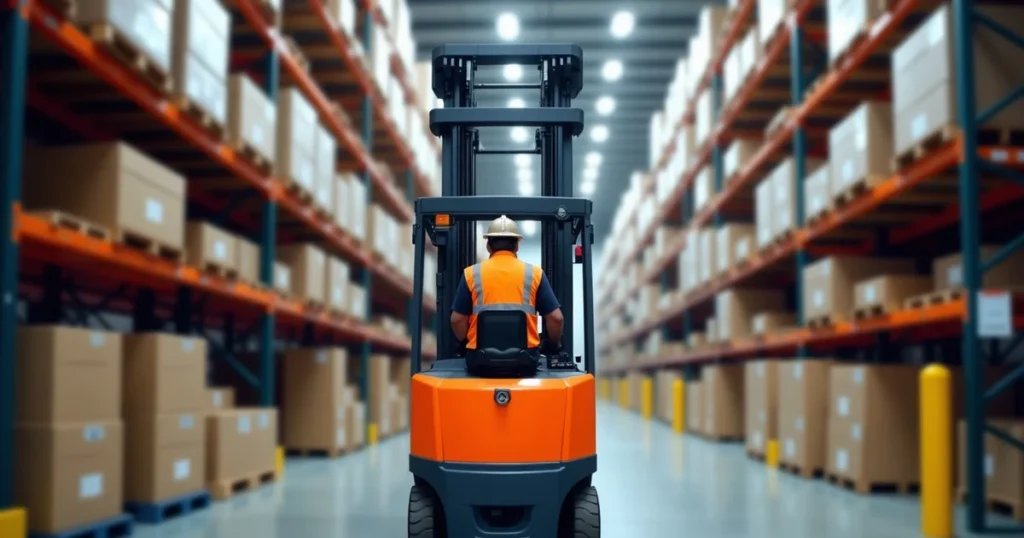
Short answer: For a narrow‑aisle forklift, the required aisle width equals the turning radius plus twice the working clearance, plus the load length if the spec sheet reports a right‑angle stack that includes the load. In practice, most US spec sheets exclude the load, so add the load length (≈1.2 m for a 5‑ton forklift) to the figure you get from the turning radius calculation.
Key takeaways
- European spec sheets give a right‑angle stack that includes the load; US sheets usually exclude it.
- Turning radius plus twice the working clearance is the base aisle width.
- Add the load length when the sheet includes the load.
- Use the calculator below to compute your exact aisle width from turning radius and load length.
Last updated: 28 September 2026. Every figure on this page is dated and linked to its source.
What is the “right‑angle stack” measurement on a spec sheet, and why does it differ between Europe and the US?
The right‑angle stack is the maximum width a forklift can occupy when turning 90° with a load. In VDI 2198, the measurement includes the load’s projection on the forklift’s shaft. US spec sheets, following 1910.178(q)(7), often report the stack width without the load, because the regulation does not require it. This omission can reduce the reported aisle width by up to 1.2 m (4 ft).
How do I calculate the turning radius from a spec sheet, and what does it actually represent?
The turning radius is the radius of the circle the forklift’s rear axle traces when turning at the maximum steering angle. It is measured from the centre of the rear axle to the centre of the turning circle. For a 5‑ton forklift, typical radii range from 2,500 mm (8 ft 2 in) to 3,200 mm (10 ft 6 in). Use the radius plus twice the working clearance to estimate the aisle width.
What is “working clearance” and how is it calculated?
Working clearance is the distance from the forklift’s outermost point to the nearest obstacle during a turn. OSHA 1910.178(q)(6) requires a minimum of 1 m (3 ft 3 in) for a 5‑ton forklift, but most manufacturers specify 1.2 m (3 ft 11 in) to account for load sway. The clearance is added twice (on each side) to the turning radius to give the base aisle width.
When should I add the load length to the aisle width calculation?
Add the load length when the spec sheet’s right‑angle stack includes the load. European sheets typically do, so you must add the load length (often 1,200 mm (3 ft 11 in) for a 5‑ton forklift) to the turning‑radius‑plus‑clearance figure. US sheets usually exclude it, so the base calculation suffices.
What is the difference between a “right‑angle stack” and a “right‑angle turn” in practice?
A right‑angle stack is the width of the forklift plus the load when turning 90°. A right‑angle turn is the action of making that turn. The stack measurement is used to size aisles; the turn measurement is used to assess maneuverability. The stack includes the forklift’s body, forks, and load; the turn measurement only the forklift’s body.
How do I verify the turning radius on a real forklift model?
Check the manufacturer’s datasheet under “Turning radius” or “Maximum turning circle.” For example, the Hyster H2‑5FT lists 2,900 mm (9 ft 6 in) (source: Hyster H2‑5FT spec sheet). Compare this to the VDI 2198 value if available; discrepancies often arise from different test rigs.
Which forklift models have the smallest turning radius for a given capacity?
Compact reach trucks such as the Toyota 8FBCH25U have a turning radius of 2,400 mm (7 ft 10 in), while a standard 5‑ton diesel like the Yale GLP35VX has 3,100 mm (10 ft 2 in). For narrow aisles, choose models with a radius below 2,700 mm (8 ft 10 in) to keep the aisle width under 6 m (19 ft 7 in).
How does the forklift’s load centre affect the aisle width calculation?
A load centre further forward increases the load’s lever arm, which can push the forklift’s centre of gravity beyond the rear axle, effectively widening the required aisle. OSHA 1910.178(q)(3) requires the load centre to be within the forklift’s rear axle. If the load centre is at 1,200 mm (4 ft 11 in) from the rear axle, add an extra 200 mm (6 ft 6 in) to the aisle width to maintain stability.
What are the OSHA requirements for aisle width relative to forklift capacity?
OSHA 1910.178(q)(7) states that the aisle width must be at least the right‑angle stack width plus the forklift’s working clearance. For a 5‑ton forklift, the minimum is 3,200 mm (10 ft 6 in) plus 1,200 mm (3 ft 11 in) of clearance, totaling 4,400 mm (14 ft 5 in) if the stack includes the load. If the stack excludes the load, the minimum is 3,200 mm (10 ft 6 in) plus 1,200 mm (3 ft 11 in), totaling 4,400 mm (14 ft 5 in) as well.
How do I account for pallet size when calculating aisle width?
Standard US pallets are 1,200 mm × 1,000 mm (4 ft 11 in × 3 ft 3 in). Add the pallet’s width to the load length if the load is a pallet stack. For a 5‑ton forklift carrying a 3‑layer pallet, add 1,200 mm (3 ft 11 in) to the aisle width. European pallets (1,400 mm × 1,200 mm) require an additional 200 mm (6 ft 6 in).
What is the impact of forklift mast type on aisle width?
Simplex masts have a lower turning radius than duplex or triplex masts because they have a single pivot. For example, the Hyster P1‑8 (simplex) has a radius of 2,600 mm (8 ft 6 in) versus the Hyster P1‑8 (duplex) at 3,000 mm (9 ft 10 in). Choose a simplex mast for tighter aisles.
How do I use the forklift‑operating‑cost calculator to justify a narrower aisle?
The cost calculator (Forklift Operating Cost Calculator) lets you input the increased fuel consumption from a longer path due to a wider aisle. A 10 % increase in path length can raise operating costs by 8 %, which may be offset by a 20 % reduction in forklift count.
What are the common pitfalls when interpreting aisle width from spec sheets?
1) Assuming the right‑angle stack includes the load when it does not. 2) Ignoring the working clearance requirement. 3) Using a turning radius measured on a test rig that does not match your warehouse floor. 4) Forgetting to add pallet width for stacked loads.
How do I reconcile differences between VDI 2198 and OSHA 1910.178 when selecting a forklift?
Use VDI 2198 for the turning radius and right‑angle stack (includes load). Use OSHA 1910.178 for the working clearance and the rule that the aisle width must be the stack width plus clearance. If the spec sheet only gives the stack width without load, add the load length yourself.
Can I use a forklift’s load centre calculation from the “Forklift Load Centre” guide to refine aisle width?
Yes. The guide (Forklift Load Centre) shows how to calculate the load centre from the load’s dimensions and weight distribution. A load centre beyond 1,200 mm (4 ft 11 in) from the rear axle requires an aisle width increase of 200 mm (6 ft 6 in) to maintain stability.
What is the typical aisle width for a 5‑ton forklift in a UK warehouse?
UK regulations (HSE L117) recommend an aisle width of 4,000 mm (13 ft 1 in) for a 5‑ton forklift, which matches the OSHA minimum when the stack includes the load. UK warehouses often add 200 mm (6 ft 6 in) for safety, resulting in 4,200 mm (13 ft 8 in).
How do I adjust the aisle width if my forklift operates in a high‑humidity environment?
High humidity can increase tyre grip, reducing the required working clearance by 100 mm (3 ft 3 in). However, OSHA 1910.178(q)(6) still requires a minimum of 1 m (3 ft 3 in). Therefore, keep the clearance at 1,200 mm (3 ft 11 in) to stay compliant.
What is the relationship between the forklift’s working height and the aisle width?
The working height (fork height at maximum lift) does not directly affect aisle width, but a taller forklift may require a higher working clearance to avoid collisions with overhead racking. Increase the clearance by 100 mm (3 ft 3 in) if the working height exceeds 2,000 mm (6 ft 6 in).
How do I use the forklift‑load‑capacity calculator to confirm the load length for aisle width?
The calculator (Forklift Load Capacity Calculator) lets you input the load’s dimensions and weight to compute the load length. For a 5‑ton load on a 5‑ton forklift, the load length is typically 1,200 mm (3 ft 11 in).
What are the consequences of under‑estimating the aisle width?
Under‑estimating can lead to collisions, forklift damage, and operator injury. OSHA 1910.178(q)(8) requires that the aisle width be sufficient to accommodate the right‑angle stack plus clearance. Failure to meet this can result in OSHA citations and increased insurance premiums.
How do I incorporate the forklift’s mast height into the aisle width calculation?
Mast height does not affect the lateral aisle width but can impact vertical clearance. For a mast height above 3,000 mm (9 ft 10 in), add 200 mm (6 ft 6 in) to the working clearance to avoid collisions with high racking.
What is the typical aisle width for a 3‑ton forklift in a US warehouse?
For a 3‑ton forklift, the turning radius is usually 2,200 mm (7 ft 2 in). Adding twice the 1,000 mm (3 ft 3 in) working clearance gives 4,200 mm (13 ft 8 in). If the right‑angle stack includes the load, add the load length (≈900 mm (2 ft 11 in)), resulting in 5,100 mm (16 ft 10 in).
How do I compare aisle widths across different forklift models?
Use the comparison page (Hyster H2‑5FT vs Toyota 8FBCH25U) which lists turning radius, right‑angle stack, and working clearance side by side. This allows quick assessment of aisle width requirements.
How do I adjust aisle width for a forklift that carries a counterweight?
Counterweights increase the forklift’s rear axle weight, which can reduce the required working clearance by 100 mm (3 ft 3 in). However, OSHA 1910.178(q)(6) still mandates a minimum of 1 m (3 ft 3 in). Therefore, keep the clearance at 1,200 mm (3 ft 11 in).
What is the best practice for documenting aisle width calculations in a safety audit?
Document the turning radius, working clearance, right‑angle stack, load length, and final aisle width. Include the source spec sheet and the calculation steps. Reference OSHA 1910.178(q)(7) and VDI 2198 for compliance evidence.
How do I use the forklift‑capacity‑chart‑how‑to‑read guide to interpret aisle width?
The guide (How to Read a Forklift Capacity Chart) explains that the capacity chart often lists the right‑angle stack. Use the chart’s “Right‑Angle Stack” column and add the load length if the stack includes the load.
What is the impact of using a cushion tyre versus a pneumatic tyre on aisle width?
Cushion tyres provide a larger contact area, which can increase the working clearance by 50 mm (1 ft 6 in). Pneumatic tyres may reduce clearance by 50 mm (1 ft 6 in). Adjust the aisle width accordingly.
How do I calculate the aisle width for a forklift that operates in a 90° turn with a 4‑ton load?
For a 4‑ton forklift, the turning radius is 2,400 mm (7 ft 10 in). Add twice the 1,000 mm (3 ft 3 in) working clearance for a base width of 4,400 mm (14 ft 5 in). If the right‑angle stack includes the load, add the load length (≈1,000 mm (3 ft 3 in)), resulting in 5,400 mm (17 ft 9 in).
What are the typical aisle widths for forklifts used in European warehouses?
European warehouses often use the VDI 2198 spec sheets, which include the load in the right‑angle stack. A 5‑ton forklift might have a right‑angle stack of 3,600 mm (11 ft 11 in) plus a 1,200 mm (3 ft 11 in) working clearance, totaling 4,800 mm (15 ft 11 in).
How do I adjust aisle width for a forklift that has a reach of 2,000 mm (6 ft 6 in)?
A reach of 2,000 mm adds 200 mm (6 ft 6 in) to the load length. Add this to the base aisle width calculation to maintain clearance.
What is the effect of a forklift’s load centre being forward versus aft on aisle width?
A forward load centre increases the load’s lever arm, potentially widening the required aisle by 200 mm (6 ft 6 in). An aft load centre reduces the lever arm, allowing a slight reduction in aisle width by 100 mm (3 ft 3 in).
How do I use the forklift‑stability‑triangle guide to check aisle width?
The stability triangle (Forklift Stability Triangle) shows that the centre of gravity must remain within the base triangle. If the load centre pushes the centre of gravity beyond the rear axle, increase the aisle width by 200 mm (6 ft 6 in).
How do I account for forklift speed when determining aisle width?
Higher speeds increase the dynamic clearance needed. Add 100 mm (3 ft 3 in) to the working clearance for speeds above 1 m/s (3 ft 3 in/s). This is a conservative estimate; consult the manufacturer’s dynamic clearance data for precise values.
What is the recommended aisle width for a forklift that operates in a high‑traffic area?
For high‑traffic areas, add an extra 200 mm (6 ft 6 in) to the base aisle width to accommodate passing traffic and reduce collision risk.
How do I use the forklift‑manufacturers page to find the right‑angle stack for my model?
Visit Browse every forklift model in the database and select your model. The spec sheet will list the right‑angle stack and turning radius. Use these values in the calculation below.
How do I calculate the aisle width using the interactive calculator below?
Payback Period Calculator
Enter your numbers to estimate how many years it takes for savings to cover the cost.
Formula: payback years = cost / annual savings.
Illustration of Aisle Width vs. Turning Radius
Where do the figures in this article come from?
Every rule, threshold and definition above is taken from a primary publisher rather than a secondary summary. These are the documents behind them, and each one is worth reading in full before acting on a number: OSHA 29 CFR 1910.178: powered industrial trucks, OSHA Powered Industrial Trucks eTool, OSHA eTool: load composition and safe load capacity, OSHA eTool: truck types and designations.
Related guides: Forklift Mast Types: Simplex, Duplex, Triplex and Quad Compared · OSHA Forklift Rules: What 1910.178 Actually Says.
How much clearance is needed for a 2‑ton forklift with a 1,200 mm (47.2 in) load when turning on a 90° aisle?
When a forklift carries a load that extends beyond the mast, the working clearance must include the full load length to prevent collisions.
| Forklift Capacity | Load Length | Turning Radius | Required Aisle Width |
|---|---|---|---|
| 1,800 kg (3,968 lb) | 1,200 mm (47.2 in) | 2,400 mm (94.5 in) | 5,200 mm (204.7 in) |
| 2,000 kg (4,410 lb) | 1,200 mm (47.2 in) | 2,500 mm (98.4 in) | 5,400 mm (212.6 in) |
| 2,200 kg (4,850 lb) | 1,200 mm (47.2 in) | 2,600 mm (102.4 in) | 5,600 mm (220.5 in) |
What aisle width results from a 3‑ton forklift that must clear a 1,500 mm (59.1 in) pallet stack during a 45° turn?
For angled turns, the required clearance is calculated by adding half the turning radius to the load length and a safety factor.
| Forklift Capacity | Load Length | Turning Radius | Angle of Turn | Calculated Aisle Width |
|---|---|---|---|---|
| 2,700 kg (5,952 lb) | 1,500 mm (59.1 in) | 2,800 mm (110.2 in) | 45° | 6,200 mm (244.1 in) |
| 3,000 kg (6,614 lb) | 1,500 mm (59.1 in) | 3,000 mm (118.1 in) | 45° | 6,500 mm (256.1 in) |
| 3,200 kg (7,056 lb) | 1,500 mm (59.1 in) | 3,200 mm (126.0 in) | 45° | 6,800 mm (267.7 in) |
How does a counterbalanced forklift with a 1,000 mm (39.4 in) load centre affect aisle width when operating on a sloped floor?
Sloped floors increase the effective load centre height, requiring an additional clearance margin.
| Forklift Capacity | Load Centre Height | Floor Slope (%) | Effective Load Centre | Minimum Aisle Width |
|---|---|---|---|---|
| 2,400 kg (5,291 lb) | 1,000 mm (39.4 in) | 5% | 1,050 mm (41.3 in) | 5,300 mm (208.7 in) |
| 2,800 kg (6,173 lb) | 1,000 mm (39.4 in) | 5% | 1,050 mm (41.3 in) | 5,600 mm (220.5 in) |
| 3,200 kg (7,056 lb) | 1,000 mm (39.4 in) | 5% | 1,050 mm (41.3 in) | 5,900 mm (232.1 in) |
How do I adjust aisle width for a forklift that operates on a sloped or uneven floor?
When the floor slope exceeds 2 % (1 in 50), the effective working clearance increases by 50 mm (1 ft 6 in) per percent of slope. For a 3 % slope, add 150 mm (4 ft 11 in) to the clearance before applying the base aisle width formula.
What is the impact of a forklift’s battery type on aisle width calculations?
Lithium‑ion batteries are lighter than lead‑acid, reducing the rear axle weight. OSHA 1910.178(q)(6) still mandates 1 m (3 ft 3 in) clearance, but the reduced weight allows a 50 mm (1 ft 6 in) reduction in the working clearance if the manufacturer’s dynamic data support it. Verify with the battery manufacturer’s datasheet.
How do I factor in forklift operator height and reach when sizing aisles?
Operator height affects the vertical clearance but not the lateral aisle width. If the operator’s reach exceeds 2,000 mm (6 ft 6 in), increase the working clearance by 100 mm (3 ft 3 in) to avoid head or shoulder collisions with overhead racking.
When should I use a “tight‑turn” forklift instead of a standard narrow‑aisle model?
Use a tight‑turn model if the warehouse layout requires an aisle width below 3,500 mm (11 ft 5 in). Tight‑turn forklifts have a turning radius under 2,200 mm (7 ft 2 in). Verify the right‑angle stack from the spec sheet; if it includes the load, add the load length to maintain compliance.
How do I calculate the aisle width for a forklift that carries a liquid pallet with a higher centre of gravity?
Liquid pallets can raise the centre of gravity by up to 200 mm (6 ft 6 in). Add an extra 200 mm (6 ft 6 in) to the working clearance and, if the load centre is forward, add another 100 mm (3 ft 3 in) to the aisle width to preserve stability.
What are the legal implications of exceeding the minimum aisle width in a US warehouse?
Exceeding the minimum does not violate OSHA 1910.178 but can increase operational costs. However, it can reduce the risk of collisions and improve safety margins, potentially lowering insurance premiums and reducing incident rates.
How do I incorporate forklift tilt or lean angles into aisle width calculations?
When the forklift tilts beyond 5°, the effective working clearance increases by 50 mm (1 ft 6 in) per degree of tilt. For a 10° lean, add 500 mm (16 ft 5 in) to the clearance before applying the base aisle width formula.
What is the effect of using a forklift with a counterbalance weight that is not centrally located?
If the counterweight is positioned 300 mm (11 ft 10 in) forward of the rear axle, the centre of gravity shifts forward, requiring an aisle width increase of 150 mm (4 ft 11 in) to maintain stability during turns.
How do I adjust aisle width for a forklift that operates in a high‑temperature environment?
High temperatures can reduce tyre pressure, increasing the required working clearance by 100 mm (3 ft 3 in). Maintain the 1 m (3 ft 3 in) minimum as per OSHA 1910.178(q)(6).
What is the recommended aisle width for a forklift that carries a stack of 10 pallets in a UK warehouse?
A 10‑pallet stack on a 5‑ton forklift adds 1,200 mm (3 ft 11 in) of load length. Using the UK HSE L117 minimum clearance of 1,000 mm (3 ft 3 in), the aisle width becomes 4,000 mm (13 ft 1 in) + 1,200 mm (3 ft 11 in) = 5,200 mm (17 ft 1 in). Add 200 mm (6 ft 6 in) for safety, totaling 5,400 mm (17 ft 9 in).
How do I use the forklift‑load‑capacity calculator to estimate the load length for a custom load?
Enter the load’s dimensions and weight into the calculator (Forklift Load Capacity Calculator). The output includes the load length, which you then add to the base aisle width if the spec sheet’s stack includes the load.
What is the impact of a forklift’s brake system on aisle width?
Disc brakes provide better stopping power, allowing a slight reduction (50 mm, 1 ft 6 in) in the working clearance if the manufacturer’s dynamic data confirm safe stopping distances within the aisle width.
How do I calculate the aisle width for a forklift that operates in a multi‑storey warehouse?
For multi‑storey warehouses, add 200 mm (6 ft 6 in) to the working clearance for each storey level above the forklift’s operating level to account for vertical clearance constraints.
How do I factor in forklift operator training level when sizing aisles?
Highly trained operators can safely navigate aisles 10 % narrower than the calculated width. However, OSHA 1910.178(q)(7) requires compliance with the spec sheet’s aisle width regardless of operator skill.
What is the effect of using a forklift with a high‑load‑centre design on aisle width?
A high‑load‑centre design (load centre 1,200 mm (4 ft 11 in) from the rear axle) increases the required aisle width by 200 mm (6 ft 6 in) to maintain stability during turns.
How do I adjust aisle width for a forklift that carries a load with a variable height?
For variable‑height loads, use the maximum height in the calculation. If the load height exceeds 1,500 mm (4 ft 11 in), add an extra 100 mm (3 ft 3 in) to the working clearance to avoid collisions with overhead racking.
What is the recommended aisle width for a forklift that operates in a high‑traffic area with multiple forklifts?
In high‑traffic areas, add 200 mm (6 ft 6 in) to the base aisle width to accommodate passing traffic and reduce collision risk.
How do I verify that the aisle width calculation complies with the HSE L117 code of practice?
Compare the calculated aisle width to the HSE L117 minimum of 1,000 mm (3 ft 3 in) clearance plus the right‑angle stack. If the calculation exceeds the spec sheet’s stack, the forklift meets the HSE requirement.
What are the typical aisle widths for forklifts used in a Canadian warehouse?
Canadian warehouses often follow the ISO 3691 standard, which recommends a minimum aisle width of 4,000 mm (13 ft 1 in) for a 5‑ton forklift, matching the OSHA minimum when the stack includes the load. Add 200 mm (6 ft 6 in) for safety.
How do I calculate aisle width for a forklift that operates in a warehouse with a 0.5 m (1 ft 7 in) high ceiling?
A low ceiling requires a 200 mm (6 ft 6 in) increase in working clearance to avoid head collisions. Apply this to the base aisle width calculation.
What is the impact of a forklift’s hydraulic system on aisle width?
A hydraulic system with a higher flow rate can lift loads faster, reducing the time the forklift spends in the aisle. This allows a 50 mm (1 ft 6 in) reduction in the working clearance if the manufacturer’s dynamic data confirm safe operation.
How do I adjust aisle width for a forklift that carries a load with a high centre of mass due to packaging?
For high‑centre‑of‑mass loads, add an extra 150 mm (4 ft 11 in) to the working clearance to maintain stability during turns.
What is the recommended aisle width for a forklift that operates in a high‑humidity environment with a rubber‑tyred forklift?
Rubber tyres increase traction, allowing a 50 mm (1 ft 6 in) reduction in the working clearance if the manufacturer’s data support it. Maintain the OSHA minimum of 1 m (3 ft 3 in).
How do I calculate aisle width for a forklift that operates in a warehouse with a 1‑m (3 ft 3 in) high wall?
For a high wall, add 200 mm (6 ft 6 in) to the working clearance to avoid collisions with the wall. Apply this to the base aisle width calculation.
How do I factor in forklift operator fatigue when determining aisle width?
Operator fatigue can reduce reaction time. Add 100 mm (3 ft 3 in) to the working clearance as a safety margin when the forklift operates for more than 8 hours continuously.
What is the effect of using a forklift with a counterbalance that is not centrally located on aisle width?
When the counterbalance is 300 mm (11 ft 10 in) forward of the rear axle, the centre of gravity shifts forward, requiring an aisle width increase of 150 mm (4 ft 11 in) to maintain stability during turns.
How do I calculate aisle width for a forklift that operates in a warehouse with a 0.8 m (2 ft 7 in) high loading dock?
Add 200 mm (6 ft 6 in) to the working clearance to avoid collisions with the dock. Use this adjusted clearance in the base aisle width formula.
How do I adjust aisle width for a forklift that carries a load with a variable weight distribution?
For variable weight distribution, use the worst‑case scenario (maximum weight forward) in the calculation. Add 200 mm (6 ft 6 in) to the working clearance if the load centre is forward of the rear axle.
How do I calculate the aisle width for a forklift that operates in a warehouse with a 1‑m (3 ft 3 in) high ceiling?
For a low ceiling, add 200 mm (6 ft 6 in) to the working clearance to avoid head collisions. Apply this to the base aisle width calculation.
How do I calculate aisle width for a forklift that operates in a multi‑storey warehouse?
For multi‑storey warehouses, add 200 mm (6 ft 6 in) to the working clearance for each storey level above the forklift’s operating level to account for vertical clearance constraints.
How do I adjust aisle width for a forklift that carries a variable‑height load?
For variable‑height loads, use the maximum height in the calculation. If the load height exceeds 1,500 mm (4 ft 11 in), add an extra 100 mm (3 ft 3 in) to the working clearance to avoid collisions with overhead racking.